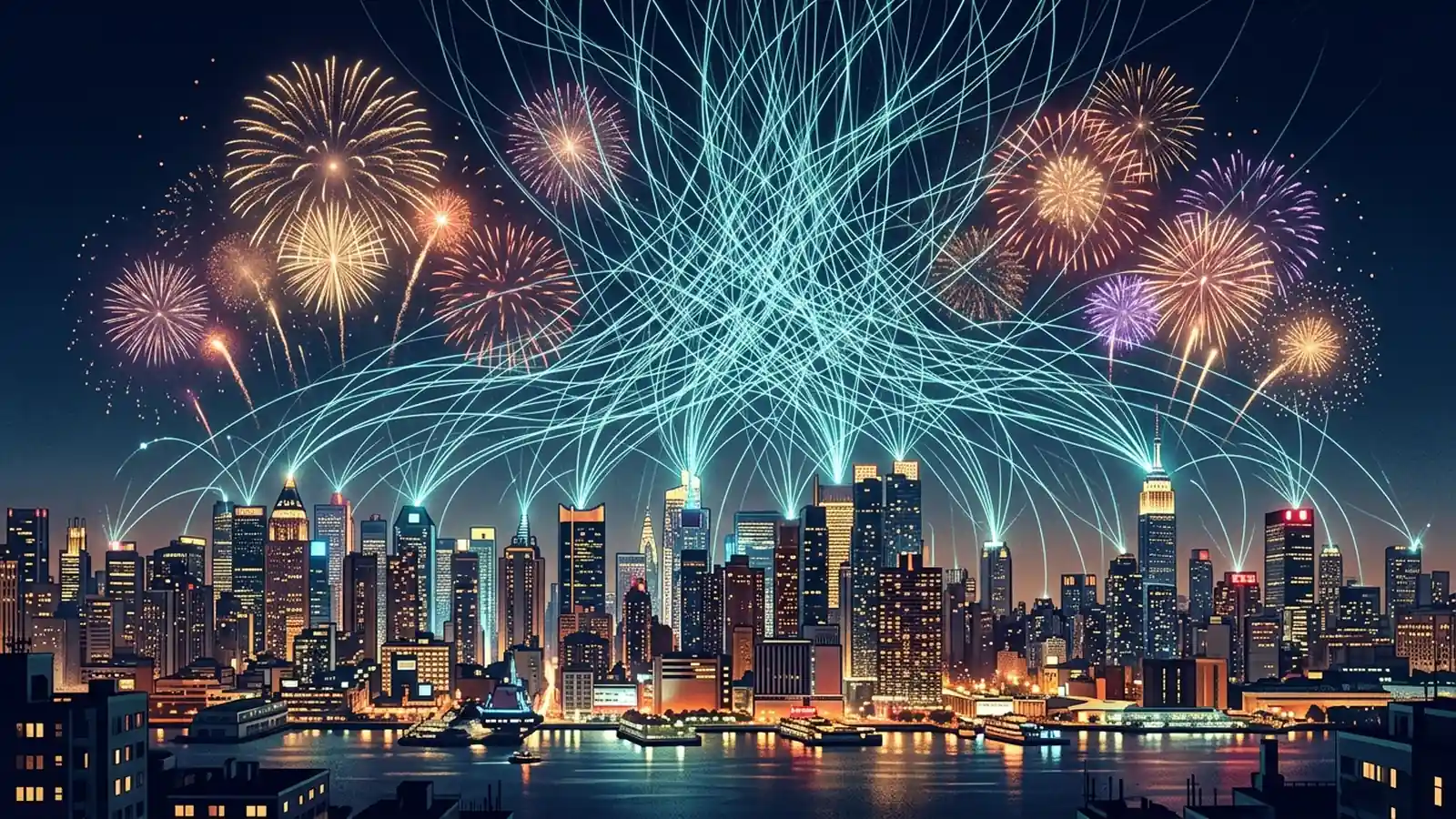
Every December 31st, at almost exactly midnight, cell networks and internet connections in every timezone experience one of the most predictable, concentrated traffic spikes of the entire year — and it's not a coincidence or a fluke, it's a genuinely unique load pattern that happens nowhere else on the calendar.
Why This Specific Moment Is Different From Normal Peak Hours
Regular peak-hour congestion (like evening streaming rushes) is spread across a few hours and across staggered individual habits. New Year's midnight is different: it concentrates an enormous share of a network's users into the exact same 60-to-120-second window, all trying to send a text, make a call, or post to social media at once. Mobile carriers have historically reported their single highest-volume text messaging moment of the entire year occurring in the minutes immediately around midnight on December 31st — a genuinely unique spike that dwarfs normal daily peak traffic.
Why Texts Get Delayed But Rarely Actually Fail
Cellular networks are engineered with queuing systems specifically because bursts like this are expected and planned for — a delayed "Happy New Year" text that arrives ten minutes late is the network's queuing system working as intended, prioritizing eventual delivery over instant delivery when capacity is temporarily exceeded. This is different from a network genuinely failing; it's closer to a very long line at a checkout counter than a store that's closed.
Why Wi-Fi and Cellular Behave Differently at Midnight
Cellular towers have a hard capacity ceiling for how many simultaneous connections and calls they can handle in a given cell — and that ceiling is exactly what gets tested at midnight, since everyone at a gathering is typically using the same nearby tower at once. Home Wi-Fi and fixed broadband don't share this same tower-capacity bottleneck, since each household's connection is a dedicated line rather than shared cellular spectrum, which is part of why sending a message over Wi-Fi (or a Wi-Fi calling feature, where supported) tends to go through more reliably than the same message over cellular data at that exact moment.
What Actually Helps at Midnight
- Connect to Wi-Fi before midnight if you're at a venue or a friend's house — it sidesteps the cellular tower bottleneck entirely.
- Send your messages a minute or two before or after the exact stroke of midnight — even a small offset from the peak second avoids most of the concentrated spike.
- Don't assume a delayed message means your phone or network is broken — it's very likely just queued behind an enormous, temporary, predictable surge.
Our Take
New Year's Eve congestion isn't a sign of bad infrastructure — it's actually a demonstration of networks handling an extreme, predictable load gracefully rather than falling over completely. A ten-minute delayed text is the system working; a complete outage would be the system failing, and that's not typically what happens even during the single busiest minute of the telecom year.
It's Not Just Texting — Social Media Posting Spikes Too
Text messaging gets most of the attention in this pattern, but the same midnight concentration applies to social media apps and photo/video sharing — a huge share of users opening the same app within the same narrow window to post a celebration photo or video creates a comparable, simultaneous load spike on those platforms' own infrastructure, separate from the cellular network congestion itself. A slow-to-post Instagram story at 12:01am is frequently this exact pattern, not a personal connection problem.
Time Zones Actually Spread the Load, Just Not Evenly Enough
Because midnight happens at a different moment in each time zone, the global spike isn't a single simultaneous event worldwide — it rolls across time zones over roughly 24 hours. That helps overall global network capacity somewhat, but it doesn't help any individual local network much, since everyone within a single time zone still hits their local towers and local network infrastructure at essentially the same moment regardless of what's happening elsewhere in the world.
Video Calls at Midnight Are the Hardest Case of All
If texting delays are common at midnight, live video calls face an even steeper challenge — a video call needs a continuous, low-jitter stream rather than a single message that can simply wait in a queue and arrive a few minutes late. Attempting a live video call at the exact stroke of midnight on a cellular connection is close to a worst-case scenario for the technology; if a call genuinely needs to happen right around midnight, starting it a few minutes early, before the peak second, and staying connected through the spike tends to hold up far better than starting cold exactly at midnight.
One More Thing to Expect
If you're hosting a gathering, it's worth setting expectations with guests in advance that midnight messaging will likely be slow everywhere, not just on your home network — a five-second framing that heads off unnecessary router troubleshooting during an otherwise good night.