The Terabit Era
5G was about connecting things. 6G is about connecting intelligence. We're talking about speeds that make downloading a holographic movie instantaneous.
Integrated Sensing and Communication (ISAC)
6G networks won't just carry data; they will act as high-resolution radar systems. Your 6G signal could detect gestures, track health metrics, and map environments in real-time without needing cameras.
The Realistic Timeline
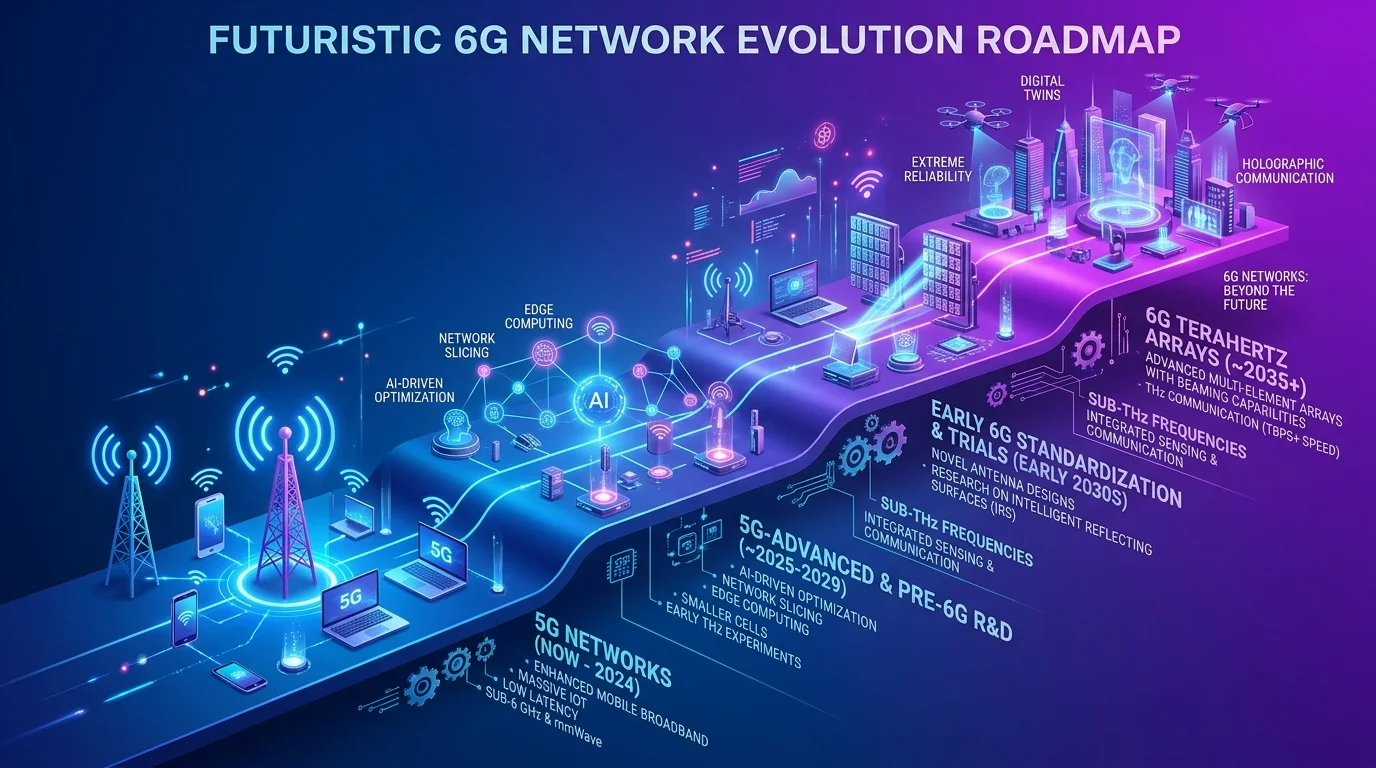
Despite the headlines, 6G won't replace your home WiFi — or your 5G Home Internet — anytime soon. The ITU's official roadmap targets standardization around 2028-2029, with the first commercial pilot deployments expected in dense urban test markets by 2030. Carriers are currently running lab trials at terabit speeds over distances measured in meters, not miles — the leap to citywide coverage is a different engineering problem entirely.
What Actually Changes for You First
Before any 6G phone reaches your pocket, expect 5G-Advanced (3GPP Release 18-20) to roll out through 2027, quietly delivering most of the latency and reliability gains 6G promises — without requiring new towers or new phones. If your current connection already feels fast and stable, 6G is a "someday" upgrade, not a "should I wait" one.
Frequently Asked Questions
When will 6G actually be available to consumers?
Realistically, not before 2030 for limited markets, with broad availability likely into the early-to-mid 2030s. Standardization itself isn't expected to complete until around 2028-2029 — every "6G launch" headline before then refers to lab trials or prototype demonstrations, not commercial service.
Should I avoid buying a 5G phone because 6G is coming?
No. 5G networks will remain the global standard for at least another decade, and 6G devices will be backward-compatible with them. A 5G phone bought today will keep working normally long after 6G launches in your area.
What Standards Bodies Are Actually Working On Now
3GPP's current focus through Release 20 remains 5G-Advanced refinements — AI-native network management, improved energy efficiency, and expanded reduced-capability device support — laying groundwork that 6G standards will build on rather than replace outright.
Why Spectrum Allocation Is the Real Bottleneck
6G's higher-frequency spectrum ambitions require international spectrum allocation agreements that move slower than the underlying technology — the World Radiocommunication Conference process alone typically takes years per allocation cycle, a structural delay independent of how fast chipmakers could theoretically ship hardware.
Frequently Asked Questions
Will 6G require replacing home WiFi equipment too? No — 6G refers to cellular network standards, separate from WiFi standards (currently WiFi 7, with WiFi 8 in development). The two evolve on independent timelines and don't require simultaneous upgrades.
How 5G-Advanced Bridges the Gap
5G-Advanced deployments beginning around 2026-2027 will introduce AI-driven network optimization and improved device battery efficiency using existing tower infrastructure — meaningful real-world improvements arriving years before any genuine 6G rollout, making it the upgrade actually worth tracking in the near term.
Frequently Asked Questions
Which countries are expected to deploy 6G first? South Korea, China, and the US are investing most heavily in early 6G research, following the same pattern of early 5G leadership — though "first deployment" in trial form differs meaningfully from broad commercial availability.