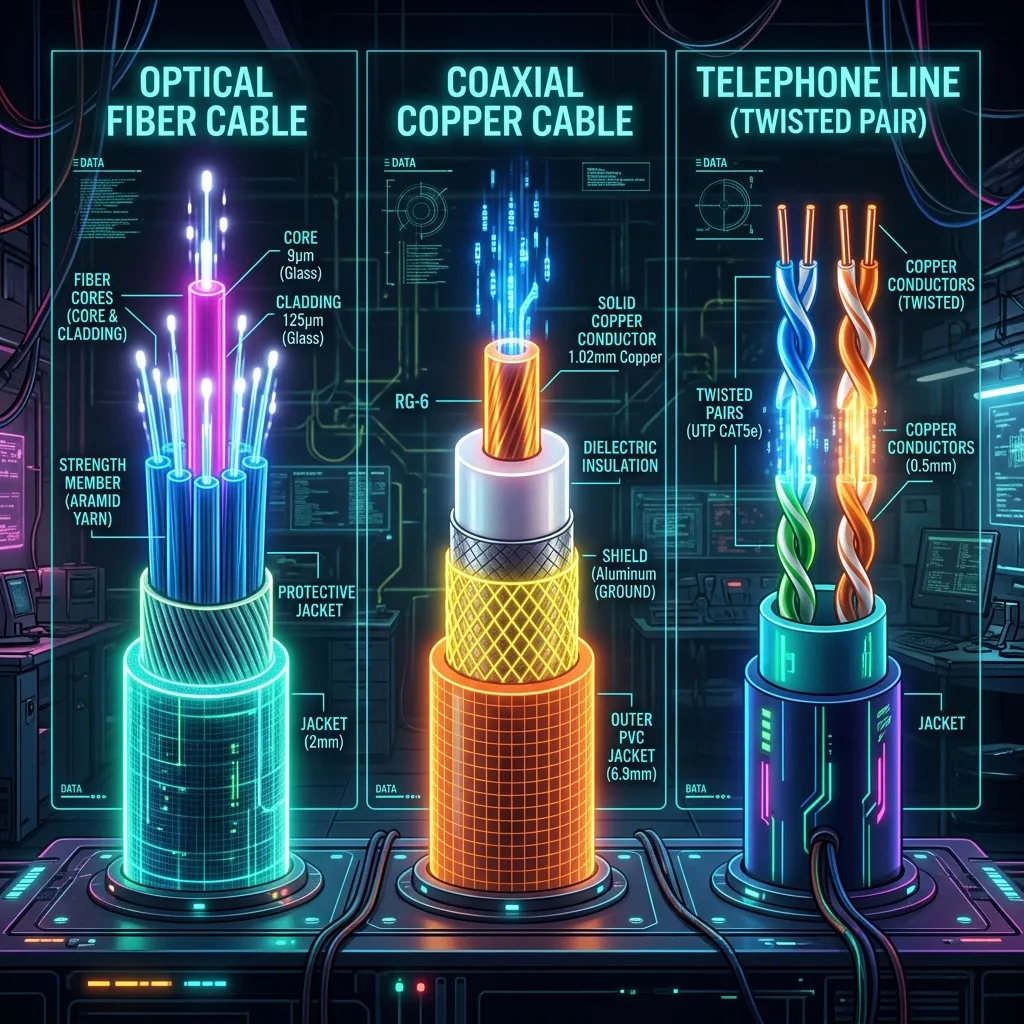
The Infrastructure Wars
Not all internet is delivered the same way. The physical medium entering your house dictates your latency floor and reliability.
Fiber (FTTH)
The Gold Standard. Data travels as pulses of light on glass strands. Immune to electromagnetic interference. Symmetric speeds (Download = Upload).
Ping Floor: ~1-3ms.
Coaxial Cable (DOCSIS)
The Incumbent. Uses existing TV cabling. Susceptible to interference and congestion if many neighbors are online. Typically Asymmetric (High Download, Low Upload).
Ping Floor: ~10-15ms.
DSL (Digital Subscriber Line)
The Dinosaur. Uses old copper telephone lines. Distance varies wildly. If you are far from the node, speed drops drastically.
Ping Floor: ~20-40ms.
Conclusion
If you have the choice, Fiber is always the correct answer for gaming, even if the “speed” (Mbps) is lower than a cheaper Cable plan. 100 Mbps Fiber beats 1000 Mbps Cable for latency stability every time.
The Real-World Decision Framework
The technology hierarchy matters less than what’s actually available and affordable at your address. If fiber is available: take it. Fiber delivers the lowest latency, highest symmetrical speeds, and most consistent performance regardless of time of day — it doesn’t share bandwidth with neighbors the way cable does. If only cable is available: cable is excellent for most households and entirely adequate for 4K streaming, gaming, and remote work. If only DSL is available: DSL’s biggest weakness is speed ceiling and distance sensitivity — a home 2 km from the DSLAM might get 50 Mbps while a neighbor 200m away gets 200 Mbps. Compare your options using the latest real-world speed data by technology type.
Frequently Asked Questions
Is fiber internet actually worth paying more for?
For most households doing remote work, video calls, or gaming: yes, if the premium is under $20-30/month. The key advantages that matter in daily use are symmetrical upload speeds (cable plans typically cap upload at 10-20% of download) and time-of-day consistency — fiber doesn’t slow down during peak hours the way cable infrastructure can. If you primarily browse and stream casually and cable is already fast at your address, the premium may not be worth it.
Why is DSL so much slower than cable or fiber?
DSL runs over copper telephone wiring not originally designed for high-speed data. Signal quality degrades significantly with distance from the telephone exchange, and the copper medium has inherent bandwidth limits even under ideal conditions. Cable uses coaxial cable designed for higher-frequency signal transmission, and fiber eliminates electrical signal limitations entirely by using light pulses through glass. The physics of each medium determine the ceiling; DSL’s copper phone wire simply can’t carry as much data as coaxial, and neither can match fiber.