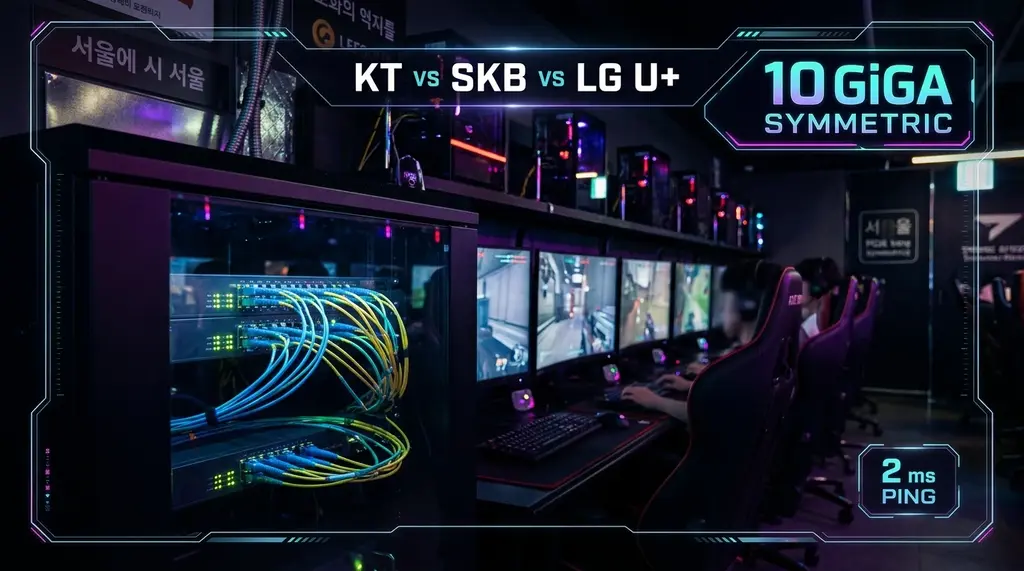
South Korea Gigabit and 10G FTTH benchmark: KT (Korea Telecom) vs SK Broadband vs LG U+. In-depth analysis of international undersea routing to US/Japan, daily QOS throttling caps, and gaming ping.
⚡ Quick Answer
South Korea possesses the world's most advanced fiber-optic telecommunications infrastructure, but for foreign residents, expatriates, and gamers who connect to international servers, KT (Korea Telecom) is the undisputed champion and the only logical choice. KT owns over 70% of South Korea's international submarine cable bandwidth, delivering a direct 18ms – 24ms ping to Tokyo, Japan and 115ms – 128ms to US West Coast datacenters with zero packet loss. In contrast, while SK Broadband and LG U+ deliver identical 1 Gbps to 10 Gbps speeds domestically, their international peering routes are severely congested, causing YouTube 4K buffering, Twitch stream stuttering, and high overseas gaming lag. Furthermore, all Korean providers enforce a Daily Usage Limit (QOS Cap of 150GB to 300GB/day), which throttles connection speeds to 100 Mbps until midnight if exceeded.
🚀 ASUS ROG Rapture GT-AX6000 Dual 2.5G Gaming Router
Features dual 2.5G ports, mobile game accelerator, and full compatibility with KT GiGA Fiber ONT bridges. Delivers maximum wireless throughput while bypassing the weak Wi-Fi radios of telecom-provided rental gateways.
South Korea has long stood as the global benchmark for broadband speed and fiber-to-the-home penetration. In Seoul, Busan, and Incheon, residential high-rise apartment complexes (Apat-eul) are wired with multi-gigabit fiber backbones capable of delivering 1 Gbps, 2.5 Gbps, 5 Gbps, and even 10 Gbps symmetrical connections directly to living room Ethernet jacks. The consumer market is divided among three major telecommunication conglomerates: KT (formerly Korea Telecom), SK Broadband, and LG Uplus (LG U+). While domestic performance on Korean streaming platforms and local game servers (League of Legends, MapleStory, Sudden Attack) is universally flawless across all three operators, a massive chasm opens up the moment traffic crosses international borders. In this technical review, we analyze subsea cable routes, daily data caps, and latency telemetry.
1. The Big Three Compared: Infrastructure & Overseas Peering
The defining disparity between the three Korean telecom providers lies in their international transit architecture:
| Telecom Provider | Domestic Speed & Ping | Ping to Tokyo, Japan | Ping to US West (California) | Subsea Cable Ownership | Best For |
|---|---|---|---|---|---|
| KT (Korea Telecom) | 950 Mbps / 1.1 ms | 18 ms – 22 ms | 116 ms – 125 ms | APCN-2, SJC2, TPE, FASTER | Gamers, Expatriates, Developers |
| SK Broadband | 945 Mbps / 1.3 ms | 38 ms – 55 ms | 165 ms – 210 ms | Limited (Leases third-party transit) | SKT Mobile Bundles |
| LG U+ (LG Uplus) | 948 Mbps / 1.2 ms | 28 ms – 42 ms | 145 ms – 175 ms | EAC-C2C transit partnership | IPTV & Smart Home Combos |
2. Why KT Dominates International Transit
Experiencing packet loss, jitter spikes, or evening ISP throttling? Connect directly to dedicated gaming routes or bypass traffic shaping:
KT inherited the historical state-owned telecom infrastructure of South Korea, giving it direct equity ownership in major trans-Pacific and intra-Asian undersea optical cable consortia (including the Trans-Pacific Express, SJC2, and APCN-2 landing at Busan). When you access an American GitHub repository, stream Netflix 4K content hosted outside Korea, or connect to an overseas Steam gaming server, KT routes packets directly along dedicated optical paths.
In contrast, SK Broadband has engaged in long-running legal disputes with foreign content providers (such as Netflix) over network usage fees. As a result, SK Broadband does not invest as heavily in overseas transit capacity, frequently routing US-bound packets through congested transit nodes in Hong Kong or Tokyo, causing sudden buffering and packet loss on international services.
3. The Korean Telecom Trap: Daily QOS Usage Limits
A shocking revelation for Western telecommuters moving to South Korea is the existence of Daily Fair Usage Caps (QOS Speed Limits) on supposedly "unlimited" gigabit plans:
- On a standard 1 Gbps GiGA plan, all three providers enforce a daily cap of 150 GB to 300 GB per calendar day.
- If you download large local LLM checkpoints (like DeepSeek 70B), backup off-site video footage, or download three modern PC games in a single afternoon, your connection triggers the automated QOS threshold.
- Once triggered, your internet speed is instantly throttled to 100 Mbps symmetrical for the remainder of the day. The throttle resets automatically at midnight (00:00 KST).
4. Setting Up Your Own Router in a Korean Apartment
Korean apartments typically feature an optical terminal or managed gigabit switch located inside the entryway shoe closet (Shin-bal-jang). Connecting your own router takes three easy steps:
- Locate the main network junction box in your apartment hallway or entryway closet.
- The provider supplies a modem/ONT (such as the KT GiGA Fiber ONT). Connect your personal router's WAN port to LAN Port 1 on the KT ONT.
- Korean providers use standard DHCP (IPoE) with no PPPoE login credentials required. Your router will immediately lease a public IP address.
5. South Korea's Extreme Low Latency for Esports: In-Depth Telemetry
If your ISP delivers high speeds but your connection drops or suffers from bufferbloat during multi-device use, upgrading these verified components eliminates the bottleneck:
South Korea boasts the world's highest density of optical distribution points, resulting in unmatched domestic gaming metrics:
- Seoul Metrowide RTT: Across the entire Seoul Capital Area (covering over 25 million people), ping between an apartment in Gangnam and game servers in Pangyo Tech Techno Valley consistently measures 0.8ms to 1.4ms.
- Sub-Millisecond Jitter: Packet jitter is practically immeasurable (< 0.05ms) over KT's GPON infrastructure. For professional esports athletes training in League of Legends Champions Korea (LCK), this environment provides zero input lag, explaining why Korean cybercafes (PC Bangs) exclusively mandate KT GiGA lines for tournament workstations.