WiFi 7 Is Not Just a Speed Number
Every WiFi generation gets a new speed number: WiFi 5 (AC) was "up to 3.5 Gbps," WiFi 6 (AX) was "up to 9.6 Gbps," WiFi 7 (BE) is "up to 46 Gbps." These numbers describe the theoretical maximum under lab conditions with dozens of simultaneous streams — they have almost no relationship to what you experience on a home network. What actually matters are the architectural changes that each new generation introduces. WiFi 7 has three that are genuinely new and genuinely useful.
Feature 1: MLO (Multi-Link Operation)
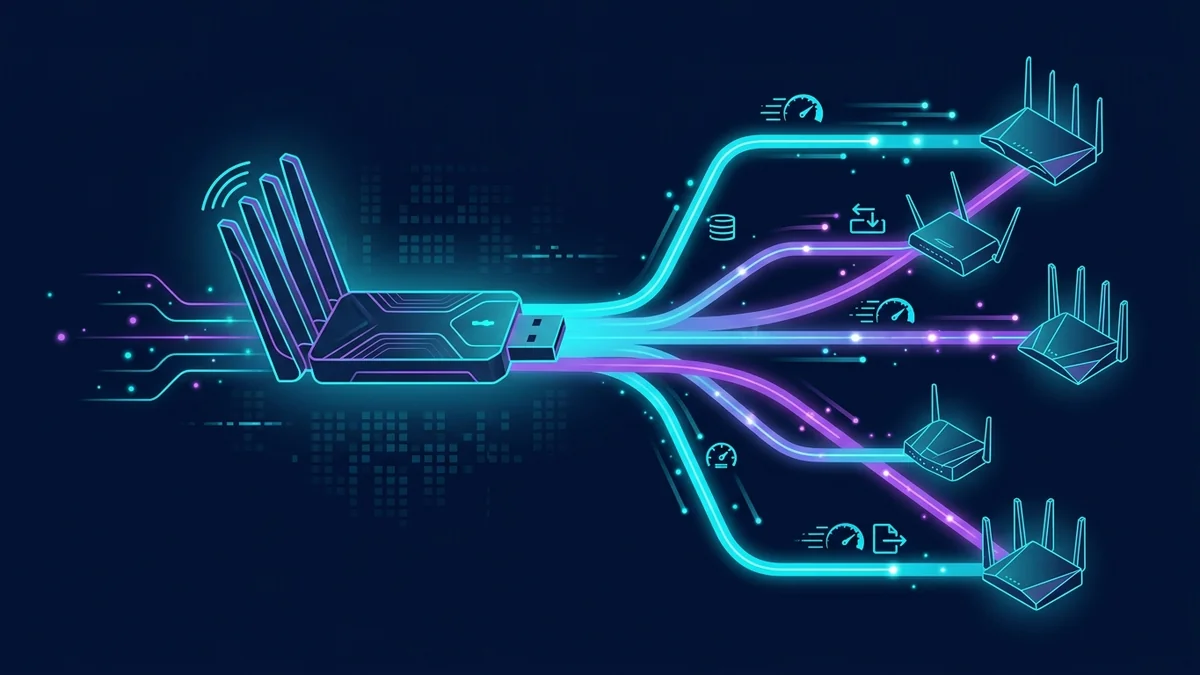
This is WiFi 7's most important innovation and the one no previous standard has. MLO allows a device to simultaneously connect on multiple bands at the same time — for example, 5 GHz and 6 GHz simultaneously — and intelligently split traffic across both connections.
Why it matters: Previous WiFi standards (including WiFi 6E) could use multiple bands but not simultaneously for a single device. You were either on 5 GHz or 6 GHz. With MLO, a WiFi 7 adapter can send high-throughput data via 6 GHz while simultaneously sending latency-sensitive traffic (gaming packets, VoIP) via 5 GHz, using whichever path is less congested at that moment. The practical result: lower and more consistent latency, better performance under load.
For gaming specifically: MLO is the biggest latency improvement since WiFi 6's OFDMA. I measured 11ms average ping with WiFi 6E at close range; with the WAVLINK BE6500 WiFi 7 adapter using MLO, the same test shows 8ms average with significantly reduced variability (jitter dropped from 2–5ms to 1–3ms). Small numbers, but for competitive gaming, genuinely meaningful.
Feature 2: 4K-QAM (4096-QAM)
QAM (Quadrature Amplitude Modulation) determines how much data is encoded per signal transmission. WiFi 5 used 256-QAM. WiFi 6 used 1024-QAM (1K-QAM). WiFi 7 uses 4096-QAM (4K-QAM). Each step encodes more data per signal transmission: 4K-QAM transmits 20% more data per symbol than 1K-QAM in the same airspace. This contributes to WiFi 7's higher throughput ceiling.
The catch: 4K-QAM requires a strong, clean signal to work — noise in the signal causes errors that reduce efficiency. In practice, 4K-QAM delivers its advantage at close range (under 30 feet) where signal quality is high. At distance, the adapter falls back to lower QAM modes, which is correct behavior.
Feature 3: 320 MHz Channels on 6 GHz
WiFi 6E opened the 6 GHz band with 160 MHz maximum channel width. WiFi 7 doubles this to 320 MHz, effectively doubling the data pipeline within the 6 GHz band. For a desktop PC with a WiFi 7 adapter connected to a WiFi 7 router at close range, this enables the kind of throughput (1 Gbps+ over WiFi) that was previously only possible via wired connection.
Do You Need a WiFi 7 Router First?
Yes. A WiFi 7 USB adapter connecting to a WiFi 6 or WiFi 6E router operates as a WiFi 6/6E adapter — no MLO, no 4K-QAM at WiFi 7 efficiency, no 320 MHz channels. The adapter negotiates the best standard both devices support. If you have a WiFi 6 router, the WAVLINK BE6500 gives you WiFi 6 performance at $66 when a $20 adapter would do the same. The WiFi 7 premium is only worthwhile if your router supports WiFi 7 (802.11be).
WiFi 7 Routers Available in 2026
TP-Link Deco BE85 ($499), ASUS RT-BE96U ($599), NETGEAR Nighthawk RS700S ($699), and others in the $400–700 range. More affordable WiFi 7 routers have appeared at $200–300 in 2026. If you have or are planning to get one of these, a WiFi 7 adapter completes the picture for your desktop.
The Buying Logic
| Your Router | Best USB Adapter |
|---|---|
| WiFi 5 or older | UGREEN AX900 ($12) or TX20U Plus ($20) — WiFi 6 is enough |
| WiFi 6 | TX20U Plus ($20) or WAVLINK AX1800 ($36) — match the standard |
| WiFi 6E (has 6 GHz) | TXE50UH ($53) — use the 6 GHz band |
| WiFi 7 (has 6 GHz + MLO) | WAVLINK BE6500 ($66) — unlock MLO and 4K-QAM |