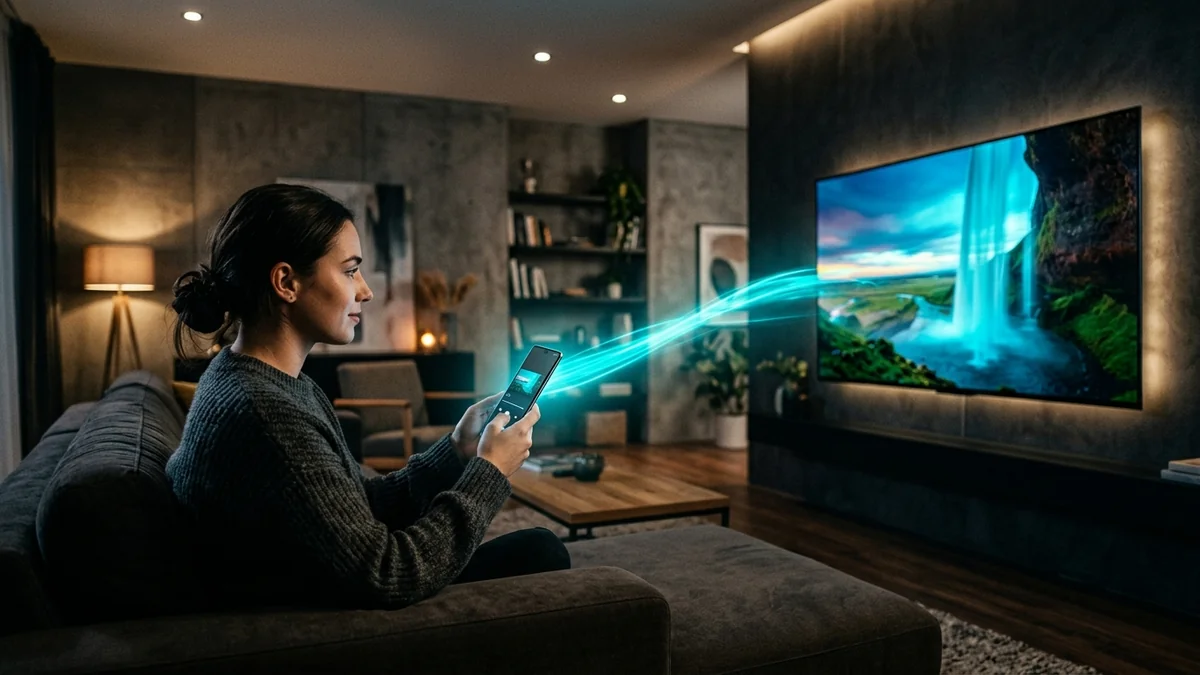
You want to share a 4K family video or mirror your iPhone screen to your living room Apple TV, LG Smart TV, or Google Chromecast. You tap the AirPlay or Cast icon, but your TV does not even appear in the device list. When it finally connects after five attempts, the video stutters violently, audio drifts out of sync, and the stream crashes after thirty seconds. You run a speed test and your broadband connection is a blazing 500 Mbps. Why do local casting protocols fail so miserably on expensive mesh Wi-Fi systems? Here is the networking reality of mDNS Bonjour Discovery, Multicast Wi-Fi Flooding, and IGMP Snooping.
The Discovery Protocol: Multicast DNS (mDNS Bonjour)
To cast video without typing an IP address, Apple devices use Bonjour (Multicast DNS / RFC 6762) and Google devices use the Cast V2 discovery protocol.
When you open the AirPlay menu, your iPhone broadcasts a continuous stream of UDP packets to multicast address 224.0.0.251 on port 5353. In a multi-node mesh Wi-Fi system, these multicast discovery packets must traverse the wireless backhaul between satellite nodes. Many consumer mesh routers mishandle or drop inter-node multicast discovery frames to conserve battery on sleeping IoT devices, causing your smart TVs and Sonos speakers to disappear randomly from your phone.
The Multicast Wi-Fi Flaw: Why Video Streams Buffer
Once connected, AirPlay and Google Cast transmit real-time video frames using Wi-Fi Multicast. Multicast on wireless networks has a fatal architectural design flaw:
| Wi-Fi Transmission Mode | Link Rate Speed | Packet Acknowledgment (ACK) | Impact on 4K Screen Mirroring |
|---|---|---|---|
| Standard Unicast (Browsing / Netflix) | High Speed (up to 1,200 Mbps) | Yes (Automatic Retransmission) | Flawless, buffer-free playback |
| Unmanaged Wi-Fi Multicast (Default AirPlay) | Lowest Legacy Rate (6 to 24 Mbps) | NO (Fire-and-forget; Zero ACKs) | Severe frame loss, stuttering, desync |
| Multicast with IGMP Snooping Enabled | Full Link Rate (Unicast Converted) | Yes (100% Reliable Delivery) | Pristine 4K 60fps screen mirroring |
Because standard Wi-Fi multicast is broadcast without transmission acknowledgments, if a single radio frequency spike or microwave interference pulse occurs, those video packets are dropped forever, causing your TV screen to freeze into green pixel artifacts.
The 3 Router Settings That Permanently Fix AirPlay & Chromecast
Log into your primary router or mesh administration panel and apply these three optimizations:
- Enable IGMP Snooping & Multicast Enhancement: Look under Wireless > Professional or LAN > IPTV for 'Enable IGMP Snooping' and 'Enable Wireless Multicast Forwarding'. This instructs the router's switching ASIC to convert multicast streams into reliable, acknowledged unicast transmissions directly to your TV's MAC address.
- Set Multicast Rate to OFDM 24 Mbps (or Higher): In advanced wireless settings, raise the minimum multicast beacon rate from 1 Mbps/6 Mbps to 24 Mbps (OFDM). This forces your Wi-Fi radios to transmit discovery and streaming beacons at high speed, freeing up massive amounts of wireless airtime.
- Disable 'AP Isolation' (Client Isolation): Verify that 'AP Isolation' is disabled on both 2.4 GHz and 5 GHz SSIDs so your phone can freely communicate with smart TVs and speakers.
Why Dual-Band Smart TVs Get Stuck on 2.4 GHz AirPlay
Many smart TVs feature low-cost Wi-Fi cards that automatically associate with the 2.4 GHz band because of its stronger signal strength, even when a 5 GHz band is available. On 2.4 GHz, heavy Bluetooth interference and neighbor congestion drop AirPlay screen mirroring bitrates below usable thresholds.
Binding your Smart TV's MAC address strictly to the 5 GHz Wi-Fi band in your router settings guarantees high bandwidth and eliminates AirPlay stuttering.
Diagnostic Testing: Using Discovery App to Audit mDNS Bonjour
To verify if your local network is broadcasting mDNS services properly, download the free Discovery (DNS-SD) app on iOS or macOS. It lists all active _airplay._tcp and _googlecast._tcp instances on your network in real time, confirming whether mesh nodes are forwarding casting beacons across rooms.
Why WPA3-Personal Security Enhances AirPlay Stability
Modern Wi-Fi routers supporting WPA3-Personal utilize Simultaneous Authentication of Equals (SAE) and protected management frames. This prevents de-authentication spoofing attacks from knocking smart displays and wireless speakers off the network during active media sessions.
Upgrading your home Wi-Fi network to WPA3-SAE ensures secure, rock-solid device pairing across all AirPlay and Google Cast smart devices in your home.
Achieving Flawless Smart Screen Casting
By enabling IGMP Snooping on your router, raising multicast transmission rates, and binding smart displays to clean 5 GHz Wi-Fi channels, you convert flaky local casting into an instant, high-speed 4K streaming experience across all Apple and Google smart displays.
Understanding DTIM Interval Settings for AirPlay Discovery
In your router wireless settings, the Delivery Traffic Indication Message (DTIM) interval determines how often the router wakes up sleeping wireless clients to deliver buffered multicast traffic. Setting DTIM to 1 or 3 ensures that Apple TVs and AirPlay speakers receive real-time discovery frames without entering deep sleep states.
Summary Checklist for AirPlay and Chromecast Optimization
In summary: enable IGMP Snooping, set multicast rates to 24 Mbps, disable AP client isolation, and bind smart TVs to 5 GHz. Your Apple AirPlay and Google Cast streams will connect instantly and mirror in pristine 4K 60fps.