What Is Jitter and Why Is It 10x Worse Than High Ping for Gaming and Video Calls?

What Is Jitter and Why Is It 10x Worse Than High Ping for Gaming and Video Calls?

Ask any casual internet user what makes an internet connection good for online multiplayer or video calls, and they will immediately point to two numbers: download speed (Mbps) and ping (latency in ms). Yet, you can have a gigabit fiber connection with an average ping of 20ms and still experience unbearable rubberbanding in Counter-Strike 2, frozen frames in Zoom meetings, and dropped Discord voice sentences. The hidden villain behind these micro-stutters is not ping — it is Jitter (Packet Delay Variation). Why is an erratic connection 10x worse than a slow, predictable one? Here is the mathematical truth about jitter.

Defining Jitter: Packet Delay Variation (PDV)

In network measurement standards (IETF RFC 3393), Jitter is defined as the absolute mathematical difference in latency between successive packets traversing a network path:

$$Jitter = |Latency_{Packet 2} - Latency_{Packet 1}|$$

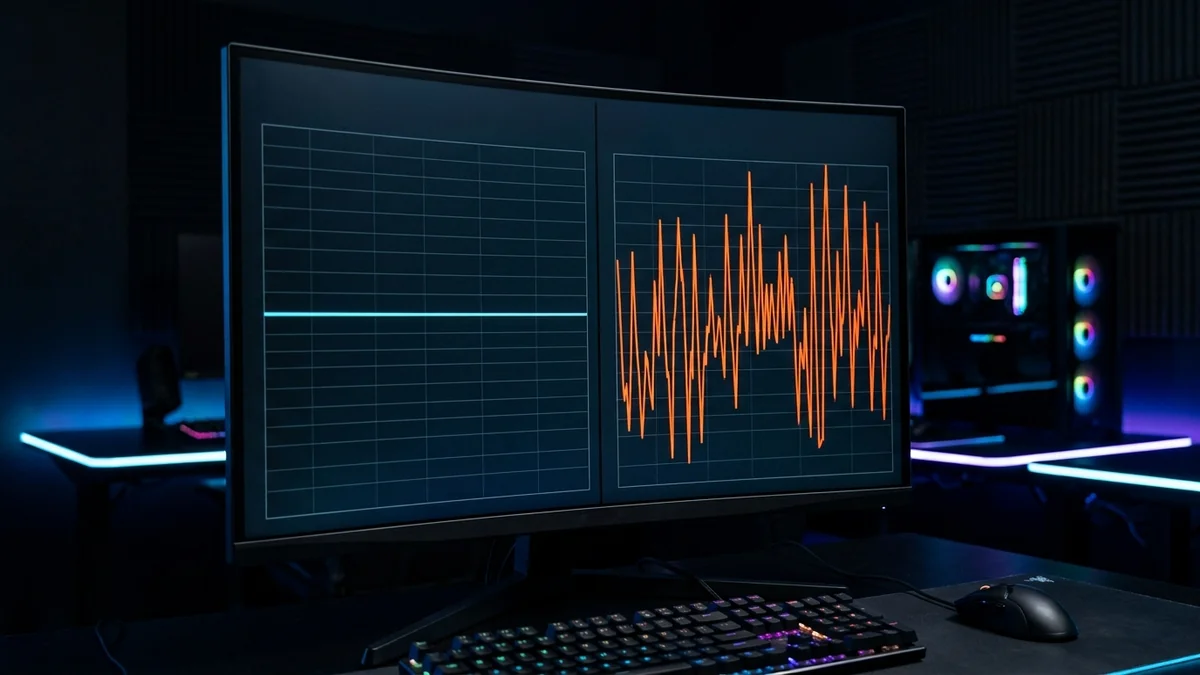
Imagine driving on a highway. Having a steady ping of 60ms is like driving smoothly at 60 mph in a straight lane. Having high jitter (20ms jumping to 140ms) is like driving at 80 mph, slamming on the brakes to 10 mph every three seconds, and accelerating again. The average speed might look fine, but the ride is completely chaotic.

Comparative Table: Stable High Ping vs Unstable Low Ping

Below is how modern real-time game engines and WebRTC video codecs process stable vs jittery network streams:

Network Scenario Latency Profile (10 Packets) Measured Jitter ($\Delta$) Multiplayer Game Behavior Zoom / Discord Audio Quality
Scenario A: Stable High Ping 60ms, 60ms, 61ms, 60ms, 60ms ±0.4 ms (Pristine) Smooth interpolation; clean hit-reg Crystal clear audio (No delay buffer)
Scenario B: Erratic Jittery Ping 18ms, 120ms, 22ms, 95ms, 15ms ±48.5 ms (Severe) Violent rubberbanding & teleporting Robotic voices, dropped syllables

How Game Netcode and Jitter Buffers Collapse

To understand why Scenario B is unplayable, you must look at how game engines handle incoming packets:

  • Lag Compensation & Client Interpolation: When packets arrive at exact 7.8ms intervals (128-tick rate), the game engine smoothly interpolates enemy player models. When jitter delays three consecutive packets, the engine runs out of data, halts the enemy model on screen, and snaps them forward when the delayed packets arrive in a clump.
  • WebRTC Dynamic Jitter Buffers: In Zoom or Discord, the audio engine maintains a tiny memory buffer to smooth out arrival times. When jitter exceeds 30ms, the buffer overflows or starves, resulting in robotic audio and dropped words.

The 4 Primary Culprits of Home Network Jitter

  1. Wi-Fi Channel Contention & CSMA/CA Backoff: Shared wireless airtime in dense apartments causing millisecond transmission delays.
  2. Unmanaged Upstream Bufferbloat: Background cloud backups filling router FIFO buffers.
  3. Cellular 5G Radio Scheduling: Mid-band 5G base stations dynamically reallocating time slots among neighboring smartphones.
  4. Sub-optimal ISP Peering Hops: BGP routing oscillations at regional telecommunications exchanges.

How to Measure and Kill Jitter in 2026

To diagnose and eliminate jitter on your connection:

  • Run Multi-Packet Diagnostics on DCSpeedTest: Our diagnostic suite captures continuous microsecond latency telemetry across hundreds of consecutive packets to calculate your exact inter-packet jitter score.
  • Hardwire via Cat6 Ethernet: Eliminates 95% of local wireless jitter instantly.
  • Enable Cake SQM on Your Router: Regulates packet arrival pacing with microsecond mathematical precision, delivering a tournament-grade jitter score of under 1.0ms.

Why Real-Time Voice Codecs Suffer from Packet Out-of-Order Delivery

When network jitter becomes severe, packets can actually arrive out of order (Packet 3 arrives before Packet 2). In standard file downloads, TCP reassembles the sequence effortlessly. In live voice communication (Discord/Zoom), the Opus audio codec cannot wait for delayed packets without adding massive lag, forcing the decoder to drop the late packets and generating robotic audio artifacts.

How Fiber Optic Infrastructure Permanently Tames Jitter

Because single-mode optical fiber is completely immune to electromagnetic radio interference and uses dedicated laser wavelengths, packet transit times across fiber backbones remain flat within microsecond tolerances, delivering the lowest jitter scores of any communications medium on Earth.

Understanding Bufferbloat as the Chief Engine of Jitter

The single biggest driver of domestic network jitter is Bufferbloat. When unmanaged router buffers fill up during background downloads, latency spikes erratically with every TCP window burst. Smart Queue Management (Cake) paces packets smoothly, permanently compressing jitter to sub-millisecond tolerances.

Summary: The Hierarchy of Online Gaming Connection Quality

When optimizing your network for gaming and video calls, prioritize metrics in this order: 1) Zero Packet Loss (0.0%), 2) Ultra-Low Jitter (< 2.0 ms), 3) Bufferbloat Mitigation (Grade A+), and 4) Raw Latency (Ping).

A stable 50ms connection with 0ms jitter will consistently outperform an erratic 15ms connection in every real-world multiplayer match.

The Golden Rule of Real-Time Networking

Consistency is king. Eliminating packet delay variation through Cake SQM and hardwired Ethernet provides a vastly superior gaming and calling experience than chasing raw download speed alone.

How to Calculate Jitter from Raw Ping Samples

In network diagnostics, jitter is typically calculated using the RFC 3393 formula or the Mean Opinion Score (MOS) standard. By computing the moving average of latency differences across consecutive packets, diagnostic engines quantify real-time line stability. Keeping jitter below 2ms guarantees flawless voice and gaming performance.

The Importance of Jitter Diagnostics in Remote Work

For corporate IT teams and remote professionals, measuring jitter is just as crucial as measuring download speed. A jitter score under 3ms guarantees crystal-clear HD video conferencing with zero dropped audio packets.

Frequently Asked Questions

Sources & References

See our research methodology for how we combine our own testing with public data sources.

About the Author

Dalto Cardoso is a network infrastructure engineer, broadband performance analyst, and founder of DCSpeedTest.com. Having managed multi-region server clusters and fiber routing protocols across three continents, he tests latency, bufferbloat, and routing anomalies from real-world vantage points.