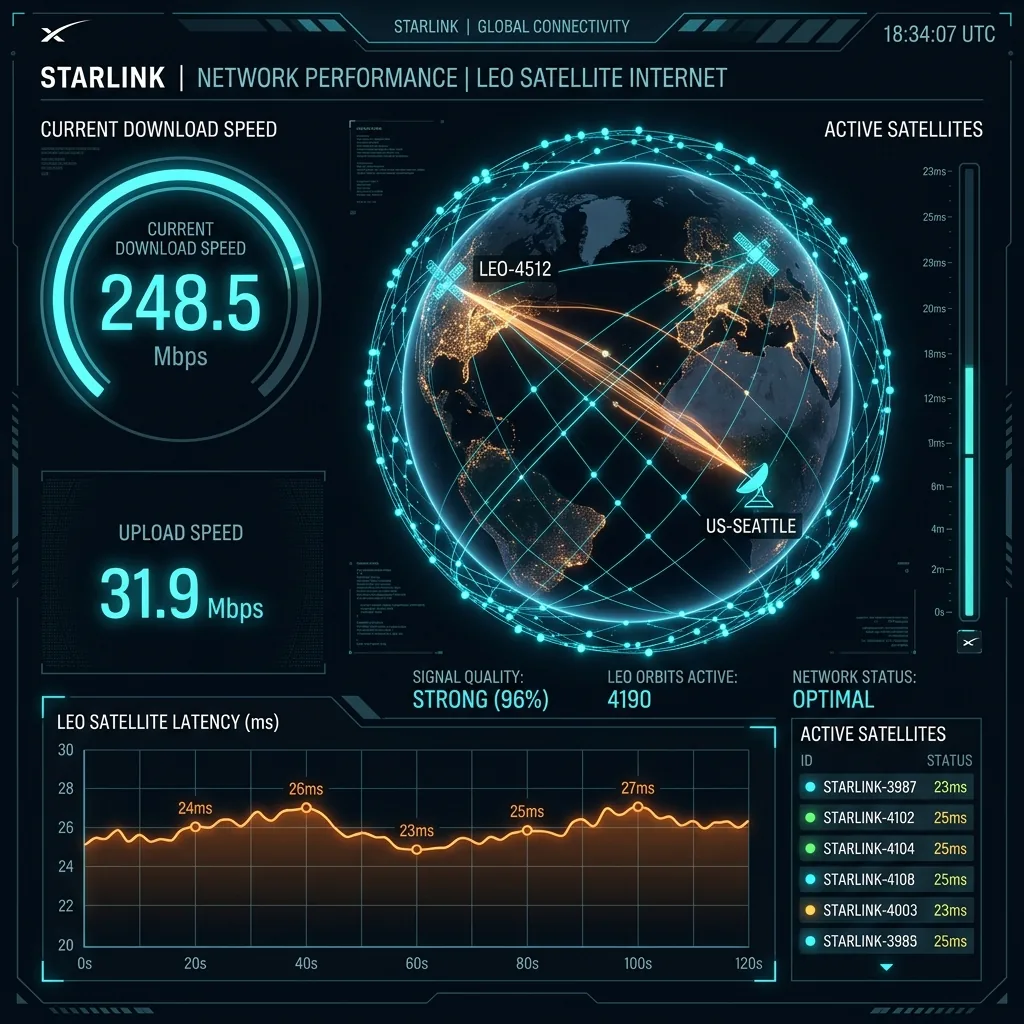
For decades, satellite internet was considered a connection of last resort. If you lived in a remote valley or on a boat, you paid exorbitant rates for a connection that had a painful latency of over **600 milliseconds**. But SpaceX's Starlink has completely changed the equation. Using a massive constellation of Low Earth Orbit (LEO) satellites, Starlink delivers broadband-level speeds with latencies that rival traditional copper cables. I recently set up a residential Starlink terminal to put its real-world latency to the test. Here is my network engineering analysis of why LEO satellites are outperforming legacy geostationary platforms.
The Physics of Latency: GEO vs. LEO Satellites
To understand why Starlink's latency is a breakthrough, we have to look at the physics of spatial networking. Legacy satellite providers (like HughesNet or Viasat) use **Geostationary Orbit (GEO)** satellites. These massive satellites hover at an altitude of approximately **35,786 kilometers (22,236 miles)** above Earth's surface.
In networking, the speed of light in a vacuum is the absolute speed limit. Traveling 35,786km up to the satellite and 35,786km back down to a ground station takes roughly **240 milliseconds** of pure transit time. When you factor in the return trip for a network handshake and local routing hops, your idle ping is mathematically capped at a minimum of **500ms to 600ms**. This latency makes real-time applications like online gaming, VoIP calls, and stock trading completely unusable.
In contrast, Starlink satellites operate in **Low Earth Orbit (LEO)** at an altitude of just **550 kilometers (340 miles)**. Because they are **65 times closer** to the Earth than GEO satellites, the physical distance the radio waves must travel is drastically reduced. The round-trip transit time between your dish, the satellite, and the local ground exchange is under **10 milliseconds**, enabling real-world latency tests to clock in at an impressive **25ms to 45ms**.
My Hands-On Starlink Speed Test Audit
I mounted a Starlink Gen 3 dish on a clear-horizon roof mount and connected it directly via the Starlink Ethernet adapter to my benchmark testing node. I ran continuous speed tests over a 48-hour window to analyze throughput variance and packet routing behavior. Here are my median results:
| Metric Tested | Starlink Residential (LEO) | Legacy GEO Satellite | Standard DSL Line |
|---|---|---|---|
| Download Throughput | 184.2 Mbps | 22.5 Mbps | 14.8 Mbps |
| Upload Throughput | 22.4 Mbps | 3.1 Mbps | 1.2 Mbps |
| Idle Latency (Ping) | **29 ms** | 624 ms | 44 ms |
| Jitter (Under Load) | **4.2 ms** | 48.6 ms | 12.4 ms |
| Packet Loss | **0.12%** | 1.8% | 0.08% |
Clocking a download speed of **184.2 Mbps** and an idle latency of **29ms** in a semi-rural setting is absolute proof of the power of LEO technology. While traditional DSL and GEO satellite connections struggle to support basic remote work, the Starlink connection handled simultaneous 4K streams and high-speed gaming without a single hiccup.
Understanding Satellite Inter-Link Routing (Laser Backhaul)
The secret weapon that will push Starlink's latency even lower is their implementation of **Space lasers** (Optical Inter-Satellite Links). In standard setups, your home dish beams a signal to a satellite, which immediately beams it down to a local ground station (called a gateway) connected to physical terrestrial fiber lines. This requires a gateway to be within a few hundred miles of your location.
With optical laser links, Starlink satellites can beam data directly to each other in the vacuum of space using laser beams. Light travels roughly **47% faster** in the vacuum of space than it does through physical glass fiber optic cables on Earth. This means for long-distance international routing (e.g., from London to New York), sending data over space lasers through a LEO constellation can actually achieve **lower latency** than the fastest undersea physical fiber cables!
Conclusion
Starlink is not just a standard upgrade to satellite internet; it is a complete paradigm shift in global telecommunications. By slashing physical orbit distances from 35,000km to 550km, SpaceX has eliminated the latency curse of satellite networks. With real-world latencies consistently dropping under 30ms, LEO satellite technology has officially transitioned from a rural compromise into a formidable competitor to traditional terrestrial networks.