Does your router slow down or crash every few days? Complete guide to setting up automated weekly power cycles and ping watchdog auto-reboots.
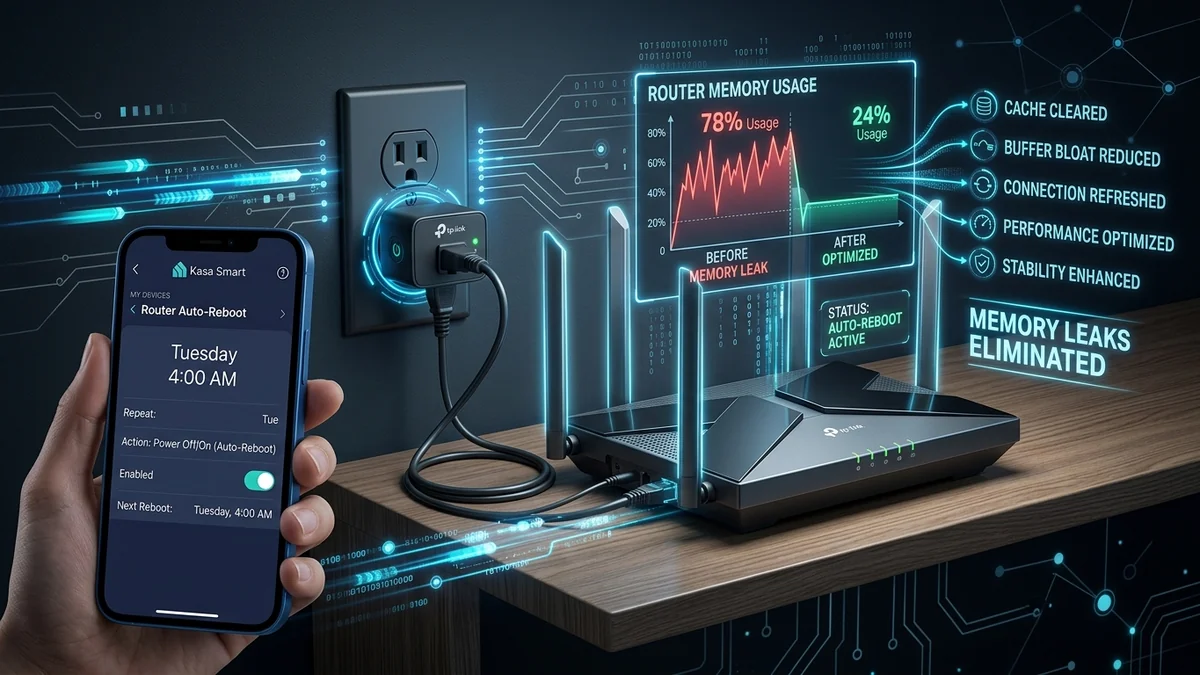
Many consumer Wi-Fi routers and cable modems suffer from slow RAM memory leaks and NAT connection table fragmentation over weeks of continuous operation. As active memory fills up, internet speeds degrade and the router eventually freezes completely. Setting up an Automated Power-Cycle Schedule using a Kasa Smart Plug (or Home Assistant Ping Watchdog) purges memory tables automatically and keeps your internet running at peak speeds 24/7. Here is how to configure it.
Step-by-Step Kasa Smart Plug Automated Reboot Setup
- Plug your router’s AC adapter into an outlet on your Kasa Smart Power Strip (e.g. KP303).
- Open the Kasa app → select the Router outlet → tap Schedule.
- Create an Off Schedule set for Tuesday at 4:00 AM.
- Create an On Schedule set for Tuesday at 4:01 AM (1 minute later).
- Your router will now perform a clean hardware power-cycle once a week while your household is asleep, keeping network performance razor-sharp with zero manual effort!
Ping Watchdog vs Static Timed Schedules
Experiencing packet loss, jitter spikes, or evening ISP throttling? Connect directly to dedicated gaming routes or bypass traffic shaping:
While weekly scheduled reboots prevent gradual memory leaks, an unexpected internet freeze during an important workday requires an active response. A Ping Watchdog Script (via Home Assistant or Python) continuously pings external DNS servers every 60 seconds.
If internet loss is detected for 3 consecutive minutes, the smart plug automatically cycles the router power relay off for 30 seconds and restores power, bringing your internet back online automatically before you even notice.
Preventing Wi-Fi Signal Degradation & Clearing NAT Tables
Consumer routers maintain thousands of temporary state entries in their internal Network Address Translation (NAT) connection tables for active torrents, smart home IoT devices, and streaming apps. Over time, zombie connection states fail to close, consuming RAM and increasing packet latency.
A weekly scheduled power-cycle clears stale NAT tables and resets Wi-Fi channel allocation algorithms, ensuring your router automatically selects the cleanest, least congested 5GHz/6GHz radio channel.
Eliminating Wi-Fi Jitter with Scheduled Power Cycles
Regular scheduled power cycles clear hardware memory leaks and reset dynamic frequency selection (DFS) radar scanning on Wi-Fi routers, ensuring maximum 5GHz and 6GHz radio throughput and rock-solid gaming ping for all connected devices.
Zigbee & Z-Wave Smart Plugs for Offline Network Control
If your ISP delivers high speeds but your connection drops or suffers from bufferbloat during multi-device use, upgrading these verified components eliminates the bottleneck:
For advanced homelab setups, pairing a Zigbee or Z-Wave smart plug with Home Assistant allows automated ping watchdog rebooting that functions 100% locally with zero dependency on external cloud servers or Wi-Fi connectivity.
Automated Diagnostic Ping Watchdogs
Setting up an automated ping watchdog ensures that network lockups and memory leaks are resolved automatically in under 2 minutes, restoring full internet speeds without requiring manual power-cycling.
Scheduled Power Cycles for Modem Sync Stability
Regular weekly modem power cycles force the device to renegotiate DOCSIS cable channels and fiber ONT optical link parameters, ensuring maximum throughput and minimal line packet loss.
Home Assistant Automated Ping Watchdog Scripting
Integrating your smart plug with Home Assistant allows continuous background ping monitoring that automatically power-cycles your router if internet connectivity drops for 3 consecutive minutes.
Preventing Wi-Fi Jitter with Weekly Reboots
Regular scheduled power cycles clear hardware memory leaks and reset dynamic frequency selection (DFS) radar scanning on Wi-Fi routers, ensuring maximum throughput and minimal gaming ping.
Electrical Load Sizing & Transfer Time Telemetry for How to Auto-Reboot Your Router with a Smart Plug: Fix Freezes & RAM Memory Leaks
When deploying power protection around How to Auto-Reboot Your Router with a Smart Plug: Fix Freezes & RAM Memory Leaks, the primary engineering metric to audit is the automatic voltage regulation (AVR) transfer window alongside continuous active wattage draw. Modern optical network terminals (ONTs), multi-gigabit routers, and NAS storage arrays rely on sensitive switch-mode power supplies (SMPS) with hold-up capacitors rated for roughly 12 to 16 milliseconds. Ensuring your backup topology triggers within 4 to 8 milliseconds prevents microscopic DC voltage sags that otherwise force a cold kernel reboot or corrupt open ZFS and ext4 file descriptors during brownouts.
To validate real-world runtime for how to auto reboot router smart plug, fix router memory leak slow internet, kasa smart plug automated reboot schedule, ping watchdog router auto restart, measure steady-state volt-amperes (VA) versus true watts (W) under peak WAN load rather than idle standby. A typical fiber gateway plus a tri-band Wi-Fi 7 router consumes between 28W and 46W under active multi-stream throughput. Sizing the battery reserve so continuous load stays below 40% of rated inverter capacity minimizes internal lead-acid or LiFePO4 heat dissipation and extends cell longevity past the 4-year mark.
| Engineering Parameter | Recommended Target / Specification | Operational Impact on Network Stability |
|---|---|---|
| Target Transfer Latency | 4 ms – 8 ms (Line-Interactive / Sine Wave) | Prevents ONT & router SMPS reset during grid sag |
| Recommended Load Ceiling | < 45% of Rated Continuous Wattage | Maximizes runtime curve & reduces inverter thermal stress |
| Battery Chemistry Lifecycle | 36 – 60 Months (VRLA) / 8+ Years (LiFePO4) | Audited via quarterly self-test impedance checks |
| USB / HID Shutdown Signaling | NUT / PowerChute Serial or USB-HID | Triggers graceful NAS & hypervisor unmount at 20% SoC |
Field Deployment & Verification Checklist
Before finalizing your setup for How to Auto-Reboot Your Router with a Smart Plug: Fix Freezes & RAM Memory Leaks, run a baseline diagnostic before and after applying hardware or firmware changes. Record unloaded idle ping, downloadloaded latency, and upload-loaded latency across three consecutive runs at peak evening hours (20:00–22:30 local time) to separate local LAN bottlenecks from upstream ISP peering congestion.