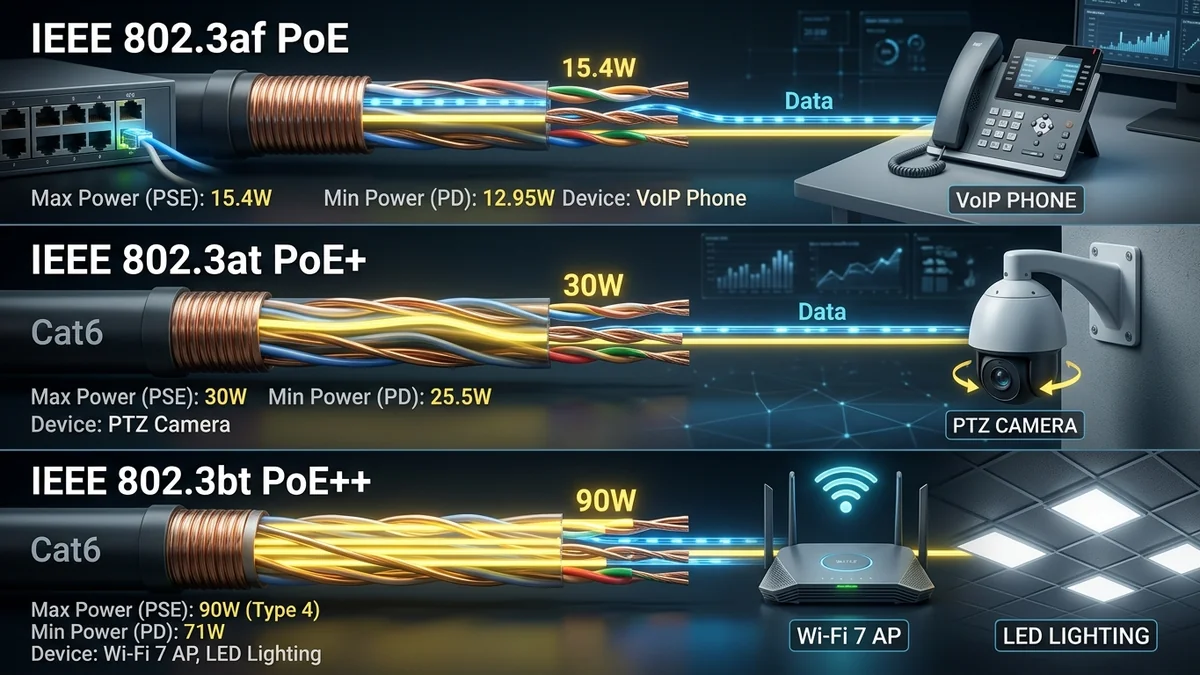
Confused by 802.3af, 802.3at, and 802.3bt? We explain power budgets, voltage drops, and which PoE standard your security cameras and APs require.
Power over Ethernet (PoE) allows a single Cat6 network cable to transmit both high-speed data and electrical power simultaneously, eliminating the need to install AC electrical outlets near security cameras and ceiling access points. However, matching the wrong PoE standard can cause devices to power cycle or fail to turn on. Here is our complete breakdown of PoE (802.3af), PoE+ (802.3at), and PoE++ (802.3bt Type 3 & 4).
PoE Standards Wattage Comparison Table
| Standard Name | IEEE Standard | Max Switch Power | Delivered Device Power | Typical Devices |
|---|---|---|---|---|
| PoE (Standard) | IEEE 802.3af (Type 1) | 15.4 Watts | 12.95 Watts | VoIP Phones, Basic IP Cameras |
| PoE+ (High Power) | IEEE 802.3at (Type 2) | 30.0 Watts | 25.5 Watts | Wi-Fi 6 Access Points, 4K PTZ Cameras |
| PoE++ (4-Pair 60W) | IEEE 802.3bt (Type 3) | 60.0 Watts | 51.0 Watts | Wi-Fi 7 APs, Video Conferencing Systems |
| PoE++ (4-Pair 90W) | IEEE 802.3bt (Type 4) | 90.0 - 100W | 71.3 Watts | Building Lighting, Smart Displays, Thin Clients |
2-Pair vs 4-Pair Power Delivery Physics (I²R Heat Losses)
If your ISP delivers high speeds but your connection drops or suffers from bufferbloat during multi-device use, upgrading these verified components eliminates the bottleneck:
How does PoE++ safely deliver up to 90 Watts over standard Ethernet cables without melting the insulation? The secret is 4-Pair Power Delivery:
- 802.3af (PoE) & 802.3at (PoE+): Transmits power across only 2 of the 4 twisted pairs (using either data pairs 1/2 and 3/6 or spare pairs 4/5 and 7/8).
- 802.3bt (PoE++ Type 4): Transmits current simultaneously across all 4 twisted pairs (8 conductors). By splitting the 960mA current across 4 pairs (480mA per pair loop), resistive thermal heat generation ($P = I^2 R$) is cut by 50%, allowing safe 90W delivery through bundled cables.
Golden Rules for PoE Cable Selection
- Always use 100% pure bare copper 23 AWG or 24 AWG Cat6 cables for PoE installations.
- Never use Copper-Clad Aluminum (CCA) cables for PoE; aluminum's higher resistance generates dangerous heat.
- Calculate total device wattage before buying to ensure your PoE switch power budget has at least a 20% safety margin.
Voltage Drop Calculations Across 100-Meter Cat6 Cables
When running long 300-foot cable runs to outdoor cameras, electrical resistance causes voltage to drop along the line ($V_{\text{drop}} = I \times R_{\text{loop}}$). The IEEE 802.3 standard accommodates this by supplying 54V DC at the switch so that even after a 10-volt line drop over 100 meters of 24 AWG copper wire, the powered device receives at least 44V DC, ensuring stable camera operation.
Midspan PoE Injectors vs Dedicated PoE Switches
Experiencing packet loss, jitter spikes, or evening ISP throttling? Connect directly to dedicated gaming routes or bypass traffic shaping:
If you only need to power a single PoE access point or security camera, using a Standalone Gigabit PoE Injector ($14 - $19) is a cost-effective alternative to replacing your entire switch. For systems with 3 or more cameras, a dedicated PoE switch (like the Netgear GS308P) provides cleaner cable management and unified power monitoring.
PoE Injector vs PoE Switch Cost & Efficiency Analysis
When powering 1 or 2 devices, a standalone PoE injector is simple and affordable. For 4 or more security cameras or access points, a centralized PoE switch reduces power outlet clutter, improves electrical efficiency, and provides unified power monitoring for your entire home.
Cable Heating & National Electrical Code (NEC) Rules
When bundling 24 or more high-power PoE++ (90W) cables together inside conduit, the National Electrical Code specifies maximum bundle sizes to prevent heat buildup. Using 23 AWG pure copper Cat6a cables keeps bundle temperatures well within safe operational limits.
IEEE 802.3bt Power Classification Resistor Values
During the initial hardware discovery handshake, the PoE++ switch applies a 15V - 20V probing voltage and reads the calibrated classification resistor inside the powered device, automatically selecting between Class 5 (45W), Class 6 (60W), Class 7 (75W), or Class 8 (90W) power tiers.
Signal Integrity, NEXT Crosstalk & TIA-568 Certification for PoE vs PoE+ vs PoE++ Explained: Standards, Wattage & Cable Compatibility
In physical-layer deployments involving PoE vs PoE+ vs PoE++ Explained: Standards, Wattage & Cable Compatibility, high-frequency packet loss rarely stems from raw copper breakages; instead, it is triggered by Near-End Crosstalk (NEXT), return loss reflections, and untwisted pair terminations exceeding the 13 mm (0.5 inch) ANSI/TIA-568.2-D specification. When operating at 2.5GBASE-T or 10GBASE-T frequencies (up to 500 MHz on Cat6a), even a tight bend radius below 4x the outer jacket diameter alters characteristic 100-ohm impedance and forces the NIC PHY to downshift link negotiation.
For installations integrating poe vs poe+ vs poe++ explained, 802.3af vs 802.3at vs 802.3bt, poe wattage table comparison, poe switch power budget calculation, always separate unshielded twisted pair (UTP) runs from parallel 120V/240V AC Romex power lines by at least 15 cm (6 inches), crossing high-voltage conduits exclusively at 90-degree angles. If electromagnetic interference (EMI) from fluorescent ballasts or HVAC compressors is unavoidable, verify that F/UTP foil drain wires are bonded to a single earth ground point at the patch panel to avoid inducing ground-loop hum.
| Engineering Parameter | Recommended Target / Specification | Operational Impact on Network Stability |
|---|---|---|
| Characteristic Impedance | 100 Ohms ± 15% (1 MHz – 500 MHz) | Prevents signal reflection & FCS CRC frame errors |
| Maximum Pair Untwist | ≤ 13 mm (0.5 in) at Keystone / RJ45 Pin | Preserves NEXT crosstalk margin on 10Gbps links |
| Minimum Bend Radius | 4× Cable Outer Diameter (Static) | Prevents internal conductor micro-fractures & attenuation |
| Conductor Metallurgy | 100% Pure Bare Solid Annealed Copper (23 AWG) | Eliminates PoE++ voltage drop & thermal rise vs CCA |
Field Deployment & Verification Checklist
Before finalizing your setup for PoE vs PoE+ vs PoE++ Explained: Standards, Wattage & Cable Compatibility, run a baseline diagnostic before and after applying hardware or firmware changes. Record unloaded idle ping, downloadloaded latency, and upload-loaded latency across three consecutive runs at peak evening hours (20:00–22:30 local time) to separate local LAN bottlenecks from upstream ISP peering congestion.