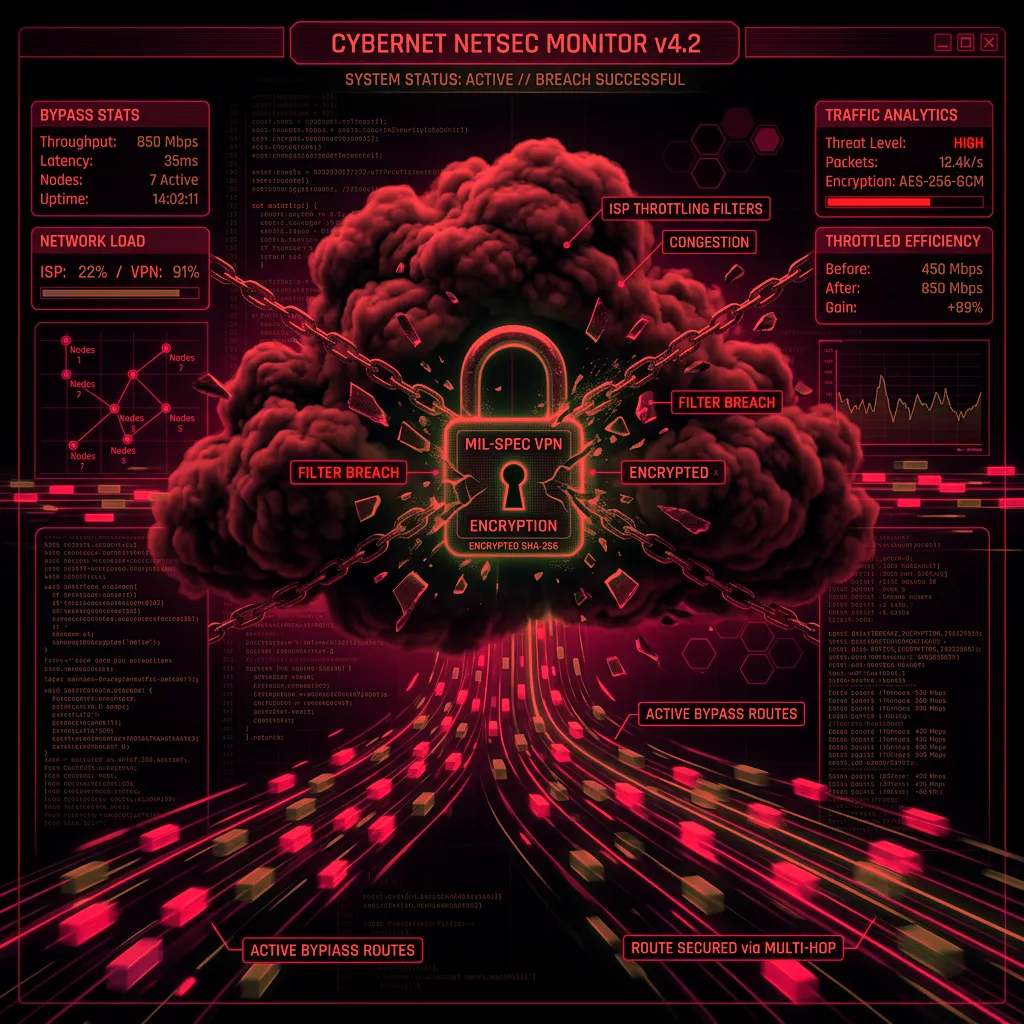
The Throttling Detection Problem
ISPs are sophisticated. They know which IPs belong to speed test servers and deliberately do not throttle that traffic — making standard speed tests useless for detecting throttling. You need tools that detect selective throttling: slowing specific apps or services while leaving speed tests untouched.
Step 1: The Baseline Comparison Test
Run DCSpeedTest first without any VPN. Note your download speed, upload speed, and ping. Then enable a VPN (ideally WireGuard protocol) and run DCSpeedTest again. If your speeds are higher with the VPN, your ISP is throttling unencrypted traffic.
Step 2: The M-Lab NDT Throttling Test
Visit speed.measurementlab.net — M-Lab's NDT test uses academic network infrastructure that ISPs do not whitelist the same way they do commercial test servers. If this result is significantly lower than your DCSpeedTest result, your ISP may be selectively throttling non-commercial traffic.
Step 3: Wehe App — Service-Specific Detection
Wehe (available for iOS and Android, developed by Northeastern University) diagnoses throttling of specific apps: YouTube, Netflix, Spotify, Amazon Prime, and others. It sends real app traffic fingerprints and measures if that specific traffic is treated differently than generic traffic — proving selective throttling to a specific service.
Step 4: Buffer Bloat Detection at Different Hours
Run DCSpeedTest at 6 AM, 12 PM, and 9 PM for five consecutive days. Record all results. If you see a consistent pattern of 30–50% speed reduction during peak hours (9 PM), that is documented evidence of network congestion from under-provisioning — actionable for FCC complaints.
What To Do With Your Evidence
- Contact your ISP: Document dates, times, test results, and screens. Request a credit or engineering visit. Most ISPs resolve documented complaints quickly to avoid escalation.
- FCC Complaint: consumercomplaints.fcc.gov — your ISP must respond within 30 days. FCC tracks complaint patterns by ISP and address area.
- State PUC: Many states have a Public Utilities Commission that regulates ISPs. A state-level complaint often gets faster resolution than federal.