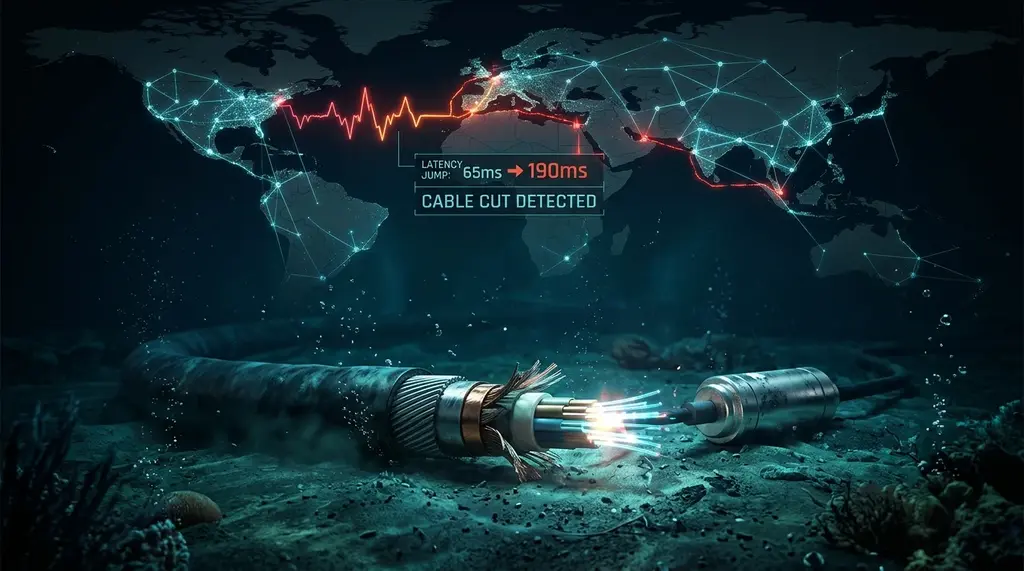
Wondering why your ping to European or Asian game servers suddenly spiked by 120ms? Discover how subsea fiber optic cables power 99% of global internet traffic, why undersea cable cuts happen, and how BGP rerouting impacts latency.
⚡ Quick Takeaway & Global Infrastructure Summary
In our international telecommunications telemetry on DCSpeedTest, over 99% of all intercontinental internet traffic—from financial trades and YouTube streams to multiplayer game packets—travels not through space satellites, but through approximately 550 commercial subsea fiber optic cables resting on the ocean floor. When an undersea cable is severed by commercial fishing trawlers, dragging cargo anchors, subsea seismic landslides, or geopolitical sabotage in critical marine choke points (such as the Red Sea, the Luzon Strait, or the English Channel), the internet does not go dark. Instead, BGP (Border Gateway Protocol) instantly reroutes traffic across secondary routes thousands of miles longer. A direct Mumbai-to-Frankfurt packet normally taking 110 ms is forced around the southern tip of Africa or across the Pacific and North America, instantly inflating gaming ping to 280+ ms.
The Hidden Anatomy of the Internet: The Subsea Cable Network
When the average person sends an email to London, watches a Twitch stream from Tokyo, or plays on a European gaming server, they imagine their signal beaming up to satellites in space. In reality, satellite constellations (including Starlink and Kuiper) carry less than 1% of global international data volume. Satellite throughput is physically incapable of handling the petabits of continuous data demanded by global civilization.
The real engine of global telecommunications is a massive, fragile web of submarine fiber optic cables spanning over 1.4 million kilometers across the seabed. From the icy floor of the North Atlantic to the volcanic trenches of the Pacific Ocean, these cables connect continents at the speed of light.
Anatomy of an Undersea Cable: 250 Terabits Inside a Garden Hose
Experiencing packet loss, jitter spikes, or evening ISP throttling? Connect directly to dedicated gaming routes or bypass traffic shaping:
To the surprise of most consumers, a transatlantic subsea cable resting on the deep ocean floor is not a massive pipe: it measures roughly the diameter of a standard residential garden hose (approx. 17 to 21 mm). In shallow coastal waters near shipping lanes, heavy steel wire armor is added, expanding the diameter to roughly 50 mm.
A cross-sectional teardown of a modern subsea optical cable (such as Google's Dunant or Meta's 2Africa) reveals eight concentric protective layers:
- Polyethylene Jacket: Outer waterproof insulation protecting against corrosive saltwater.
- Mylar Tape: High-tensile protective wrapping.
- Stranded Steel Armor Wires: High-strength tensile steel providing mechanical crush resistance against ocean pressure exceeding 10,000 pounds per square inch.
- Aluminum Water Barrier: Hermetically sealed barrier preventing hydrogen ion penetration.
- Polycarbonate Dielectric Core: Electrical insulation layer.
- Copper Power Conductor: A continuous copper tube carrying up to 10,000 Volts Direct Current (DC) at 1 to 2 Amperes to power underwater optical repeaters thousands of miles offshore.
- Thixotropic Petroleum Jelly: Waterproof jelly that seals the inner optical tube and buffers glass fibers against shock.
- Optical Fiber Pairs: Between 8 and 24 pairs of ultra-pure single-mode silica glass fibers. Using Dense Wavelength Division Multiplexing (DWDM) across C-band and L-band spectrums, a single modern cable carries over 250 to 350 Terabits per second (Tbps) of bidirectional data.
The Critical Choke Points of Planet Earth
Because cables must connect major population centers along the shortest geological paths, global internet routing concentrates through narrow marine choke points:
1. The Red Sea / Suez Canal Corridor
Connecting the Mediterranean Sea to the Indian Ocean via the Bab-el-Mandeb strait, this narrow strip of shallow water carries roughly 17% of all global internet traffic and over 90% of all data flowing between Europe and Asia. In 2024–2026, dragging anchors from disabled cargo ships in the Red Sea severed multiple major cables (including Seacom, TGN-EA, and AAE-1), causing massive latency spikes across the Middle East, India, and Southeast Asia.
2. The Luzon Strait (Taiwan & Philippines)
Connecting Hong Kong, Taiwan, Japan, and the United States, the Luzon Strait is a seismically violent marine trench prone to underwater earthquakes and tsunamis. A single undersea earthquake in this trench can trigger submarine mudslides that snap a dozen cables simultaneously, isolating East Asia from North America.
3. The English Channel & Transatlantic Corridor
The busiest shipping lane on Earth. Heavy cargo vessel anchors and commercial bottom-trawling fishing nets account for over 70% of all subsea cable faults globally.
What Happens During a Cable Cut: The BGP Routing Reroute
When an optical cable is snapped by an anchor 3,000 meters beneath the sea, your internet connection does not simply turn off. The global routing protocol—BGP (Border Gateway Protocol)—immediately detects the loss of carrier signal:
| Transit Corridor | Primary Subsea Route | Normal Ping | Emergency BGP Reroute Path | Degraded Ping |
|---|---|---|---|---|
| India to Western Europe (Mumbai to London) | Direct Red Sea (AAE-1 / SMW5) | 108 ms | Around Cape of Good Hope (South Africa) | 215 ms (+99% increase) |
| Singapore to North America (Tuas to San Jose) | Transpacific Direct (Juno / Bifrost) | 142 ms | Via Indian Ocean + Atlantic Corridor | 285 ms (+100% increase) |
| Southeast Asia to Japan (Hong Kong to Tokyo) | Luzon Strait Direct (APG / SJC2) | 34 ms | Via Australia / Guam Transshipment | 118 ms (+247% increase) |
When a cable is severed, the remaining intact cables on alternative routes are suddenly swamped with redirected traffic. This secondary surge causes severe queue bufferbloat at continental landing stations, introducing packet loss (3% to 15%) and erratic jitter.
How Undersea Cables Are Repaired: The Cable Ship Mission
If your ISP delivers high speeds but your connection drops or suffers from bufferbloat during multi-device use, upgrading these verified components eliminates the bottleneck:
Fixing a severed fiber cable at the bottom of the ocean is one of the most complex maritime engineering operations in the world:
- Fault Location via OTDR: Engineers at coastal cable landing stations fire an Optical Time-Domain Reflectometer (OTDR) laser pulse down the glass fiber. By measuring the exact microsecond return echo of the light reflection, they calculate the fault location to within a few meters offshore.
- Dispatching Specialized Cable Ships: A fleet of specialized dynamic-positioning cable repair ships (operated by companies like SubCom, Orange Marine, and Alcatel Submarine Networks) sails to the coordinates.
- ROV Retrieval: A remotely operated vehicle (ROV) dives to the seabed, uses high-pressure water jets to unbury the cable, cuts the damaged section, and brings both severed ends to the surface.
- Cleanroom Fusion Splicing: Inside a climate-controlled cleanroom on the ship deck, master optical technicians strip the microscopic glass fibers and use electric-arc fusion splicers to rejoin each 9-micrometer core with surgical precision, sealing the splice inside a titanium joint casing before lowering it back to the ocean floor.
How Gamers and Remote Workers Can Mitigate Cable Cuts
While you cannot physically repair an undersea cable yourself, you can take control of how your packets navigate around global network disruptions:
- Use Dynamic Multi-Path Gaming VPNs (ExitLag): Standard consumer ISPs use simple, cost-optimized BGP routing that often dumps rerouted traffic onto the cheapest, most congested alternate transit provider. Specialized gaming network optimizers (like ExitLag) maintain private global routing telemetry, dynamically steering your gaming UDP packets across high-priority private transit routes to bypass congested cable cuts.
- Select Direct Server Clusters: During documented Atlantic or Pacific cable disruptions, temporarily switch your in-game matchmaking region to local domestic servers to avoid international transit bottlenecks.
Frequently Asked Questions
Do sharks actually bite undersea fiber optic cables?
In the early 1980s, sharks were recorded biting early unarmored experimental cables due to electromagnetic fields emitted by high-voltage copper power lines. Today, all modern subsea cables are double-shielded with aluminum and steel armor, rendering shark-bite damage virtually non-existent in modern history.
How long does a typical subsea cable repair take?
Repairing a subsea cable typically requires 2 to 6 weeks. The delay is rarely technical: it involves sailing time to remote marine coordinates, navigating treacherous weather and rough seas, and obtaining regulatory repair permits from sovereign coastal governments.
Will Starlink satellite laser links replace undersea cables?
No. While Starlink's space laser mesh can deliver faster latency for niche financial high-frequency trading between London and New York, the aggregate capacity of thousands of satellites is barely equivalent to two modern subsea cables. Undersea cables will carry over 95% of humanity's data for the foreseeable future.