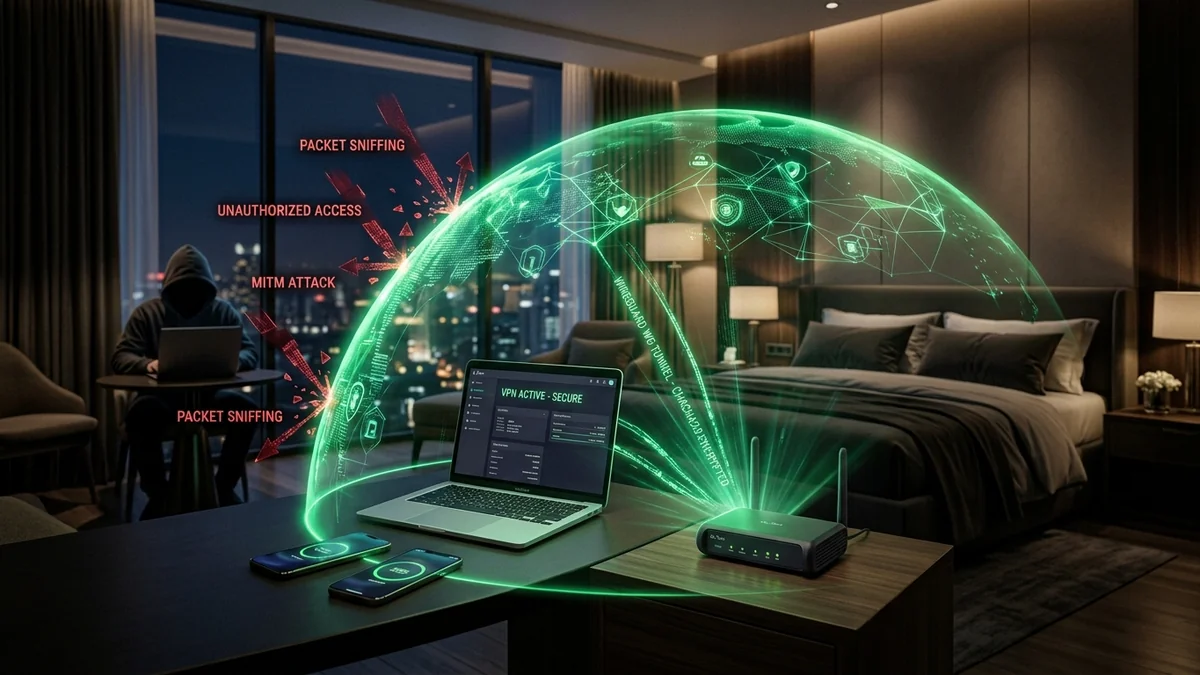
Protect your banking, work emails, and passwords on unencrypted hotel networks. Step-by-step tutorial to configuring WireGuard VPN on a GL.iNet router.
Connecting directly to open hotel Wi-Fi networks exposes your devices to local man-in-the-middle packet sniffing, rogue DNS spoofing, and ISP tracking. Setting up a whole-router WireGuard VPN client on a GL.iNet travel router ensures that 100% of network traffic from your laptops, phones, and tablets is cryptographically encrypted with modern ChaCha20-Poly1305 ciphers before leaving the room. Here is the step-by-step configuration masterclass.
Step-by-Step WireGuard Setup Walkthrough
- Log into your GL.iNet admin panel (
192.168.8.1) on your laptop or smartphone app. - Navigate to VPN → VPN Dashboard → WireGuard Client.
- Click Set Up WireGuard Manually (or choose your commercial VPN provider from the dropdown, e.g. Mullvad, NordVPN, ProtonVPN).
- Paste your WireGuard configuration file or scan the provider QR code.
- Enable the VPN Kill Switch (Block Non-VPN Traffic) to prevent IP leaks if the VPN momentarily disconnects.
- Click Start. All connected devices are now 100% encrypted!
ChaCha20-Poly1305 Cryptographic Security & Speed
Prevent evening bandwidth shaping, DNS snooping, and IP leaks across PC, mobile, smart TVs, and routers without sacrificing fiber speeds:
Disclosure: Partner affiliate links — we may earn a commission at no extra cost to you.
Unlike legacy OpenVPN (which uses heavy AES-256-CBC encryption that strains portable router processors), WireGuard utilizes ChaCha20 for symmetric encryption and Poly1305 for authentication. This lightweight mathematical structure allows the router to process encrypted packets at near-wire speeds with minimal thermal buildup.
Setting Up Policy-Based Routing (VPN Bypassing for Netflix)
Some streaming apps (like Netflix, Hulu, or BBC iPlayer) block known VPN server IP addresses. In your GL.iNet dashboard under VPN → VPN Policy, you can configure domain-based bypass rules: send banking and work traffic through the encrypted VPN tunnel while routing streaming media directly through the local internet connection.
DNS Leak Prevention & IPv6 Leak Defense
When connecting to VPNs, poorly configured devices can leak DNS queries to the local hotel network, revealing the websites you visit. In your GL.iNet dashboard, enabling DNS Rebinding Protection and Force DNS to VPN ensures all DNS requests travel exclusively inside the encrypted WireGuard tunnel with zero data leakage.
Complete Hotel VPN Setup Checklist
Never rely solely on Wi-Fi when diagnosing bandwidth throttling. Test your direct line, encrypt against ISP shaping, or upgrade to shielded Cat6A Ethernet:
- Connect the travel router to hotel Wi-Fi via Repeater Mode.
- Authenticate through the hotel captive portal via smartphone.
- Activate the WireGuard client with Kill Switch enabled.
- Verify your public IP address on
dcspeedtest.comto confirm your encrypted location!
IPv6 Leak Protection & WebRTC Leak Blocking
In addition to routing IPv4 traffic, the GL.iNet firmware automatically disables unencrypted IPv6 traffic on untrusted networks, preventing browser-based WebRTC leaks that could reveal your real geographic location to websites while traveling.
Multi-Tunnel Redundancy & Automated Failover
GL.iNet’s firmware allows you to configure multiple WireGuard server profiles (e.g. US East, US West, and Europe). If a specific server IP is blocked by a local hotel ISP, the router automatically reconnects to the backup VPN server in under 3 seconds, keeping your connection uninterrupted.
Auto-Connecting to Stored Hotel Profiles
GL.iNet routers remember previously connected hotel and airport Wi-Fi SSIDs. When you return to a familiar hotel or cafe, the router reconnects automatically and engages the WireGuard VPN without requiring manual setup.
WireGuard Keepalive Packets for NAT Traversal
Enabling Persistent Keepalive (set to 25 seconds) in your WireGuard configuration ensures that hotel firewall state tables keep your encrypted UDP tunnel open during periods of low network activity.
Cloudflare Warp & WireGuard Protocol Stability
Integrating Cloudflare 1.1.1.1 WARP directly onto your travel router provides lightning-fast encrypted DNS and CDN routing, optimizing international web browsing speeds while traveling overseas.
Multi-Device VPN Sharing for Streaming Sticks
Setting up your VPN on the travel router protects streaming sticks, Apple TVs, and smart speakers that do not support native VPN apps, allowing you to stream home media securely from any hotel room worldwide.
RF Spectrum Allocation, Airtime Fairness & Queue Discipline for How to Set Up WireGuard & OpenVPN on a Travel Router for Hotel Wi-Fi
Maximizing real-world performance with How to Set Up WireGuard & OpenVPN on a Travel Router for Hotel Wi-Fi requires moving beyond peak theoretical PHY link rates and addressing OFDMA airtime contention and WAN-to-LAN bufferbloat. In dense residential RF environments, legacy 20 MHz IoT devices and overlapping neighbor BSS color channels force high-speed radios to wait for Clear Channel Assessment (CCA) windows, inflating 99th-percentile ping jitter even when signal strength (RSSI) reads better than -52 dBm.
When tuning how to set up vpn on travel router, gl inet wireguard setup tutorial, hotel wifi security guide 2026, mullvad nordvpn on openwrt router, lock 5 GHz and 6 GHz channel widths to non-overlapping spectrum blocks and enable Smart Queue Management (CAKE or FQ_CoDel) calibrated to 90%–95% of your measured ISP line rate. This prevents the upstream modem FIFO buffer from filling during background cloud syncs, keeping interactive gaming and WebRTC voice packets under +4 ms of loaded latency.
| Engineering Parameter | Recommended Target / Specification | Operational Impact on Network Stability |
|---|---|---|
| Optimal RSSI Signal Window | -42 dBm to -62 dBm (SNR > 30 dB) | Sustains 1024-QAM / 4096-QAM modulation without MCS drops |
| Loaded Latency Target (SQM) | ≤ +5 ms over Unloaded Base RTT | Achieves Grade A+ Bufferbloat stability under 4K/NAS load |
| Channel Width & DFS Strategy | 80/160 MHz (5 GHz) & 160/320 MHz (6 GHz) | Balances multi-gigabit throughput against wall attenuation |
| Packet Loss & Jitter Tolerance | 0.0% Loss / < 2.5 ms Mean Jitter | Verified via 60-second bidirectional UDP telemetry audit |
Field Deployment & Verification Checklist
Before finalizing your setup for How to Set Up WireGuard & OpenVPN on a Travel Router for Hotel Wi-Fi, run a baseline diagnostic before and after applying hardware or firmware changes. Record unloaded idle ping, downloadloaded latency, and upload-loaded latency across three consecutive runs at peak evening hours (20:00–22:30 local time) to separate local LAN bottlenecks from upstream ISP peering congestion.