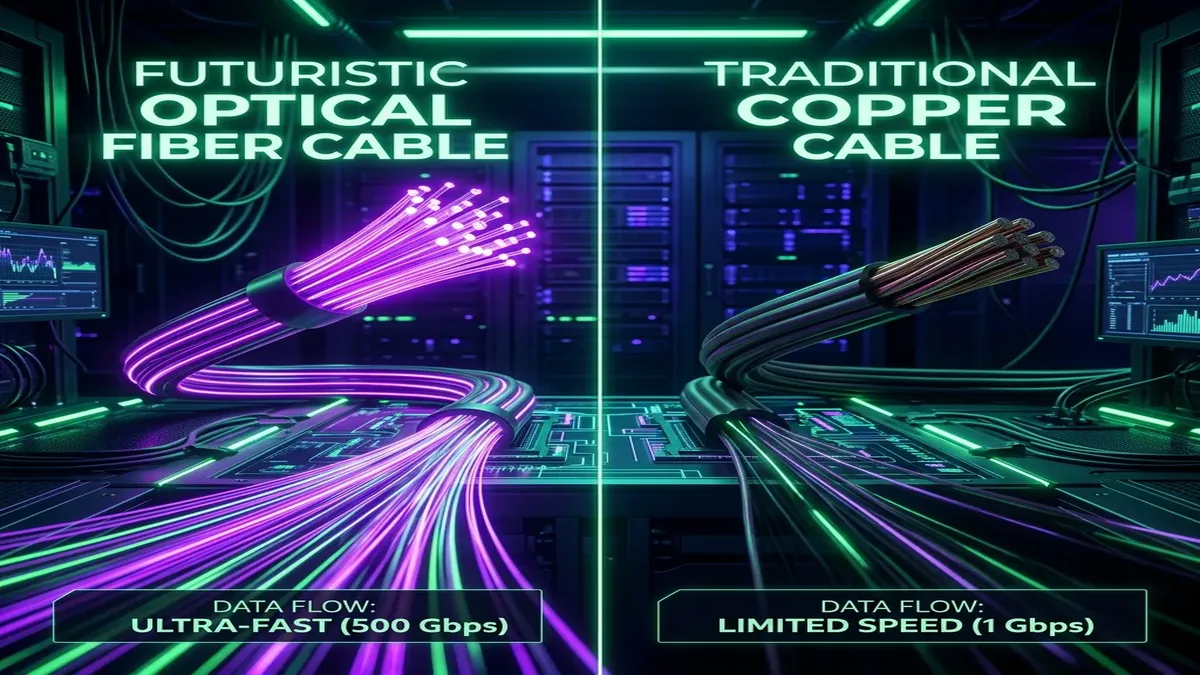
Telecom marketing departments love the word **"FIBER"**. Providers frequently advertise "Fiber-Powered Internet" or "Next-Gen Fiber Network" in glossy commercials, yet when the technician finishes installation, you find yourself with an old coaxial cable or copper telephone wire plugged into your wall, slow 10 Mbps upload speeds, and peak-hour lag. What is the difference between **True FTTH (Fiber to the Home)** and **Hybrid FTTN (Fiber to the Node)**, and how do you verify what you actually have?
1. The Fiber Spectrum: FTTH vs. FTTP vs. FTTC vs. FTTN
| Architecture | Where Fiber Ends | Final Connection to Home | Upload Speeds | Idle Ping |
|---|---|---|---|---|
| FTTH / FTTP (True Fiber) | Inside your living room (ONT) | 100% Optical Glass Fiber | Symmetric (1 Gbps – 10 Gbps) | 1 – 4 ms |
| FTTB (Fiber to the Building) | Basement telecom room | Internal Cat 6 or G.fast copper | High (100 – 500 Mbps) | 3 – 8 ms |
| FTTC (Fiber to the Curb) | Street pole / telecom pit (100m) | Copper telephone wire (VDSL2) | Asymmetric (10 – 30 Mbps) | 12 – 25 ms |
| FTTN (Fiber to the Node) | Neighborhood cabinet (1-2 miles away) | Ancient copper or coaxial line | Asymmetric (5 – 20 Mbps) | 20 – 45 ms |
2. 🔬 Why 100% FTTH (Pure Fiber) Is Far Superior
- Symmetric Upload Speeds: True FTTH delivers identical upload and download speeds (e.g. 1,000 Mbps down AND 1,000 Mbps up). This allows instant 4K video uploads, frictionless cloud backups, and crystal-clear video calls.
- Near-Zero Latency & Jitter: Light signals traveling through silica optical glass experience zero electromagnetic interference from electrical substations, weather storms, or neighbor RF noise.
- Passive Optical Network (GPON / XGS-PON): FTTH requires zero powered amplifiers along the street, meaning power outages in neighboring blocks will not interrupt your connection if your home ONT has battery backup.
3. 🔍 How to Tell If You Have Real FTTH
- Look at the Wall Jack: If the wire coming into your home is a green or blue **SC/APC optical fiber connector** plugged into an **Optical Network Terminal (ONT)**, you have true FTTH. If it connects via a screw-on metal coaxial cable or telephone jack, you have hybrid FTTN/cable.
- Run a Speed Test: If your download speed is 500 Mbps but your upload speed is only 20 Mbps, you are on hybrid FTTN or coaxial cable. True FTTH delivers symmetric upload speeds.
4. ⚡ GPON vs. XGS-PON: The 10-Gigabit Symmetrical Revolution
Behind the scenes, FTTH networks utilize passive optical splitters (Passive Optical Network - PON) to share a single feeder fiber from the central office among 32 or 64 homes:
- GPON (Gigabit PON): Delivers 2.488 Gbps download and 1.244 Gbps upload shared across a 1:32 or 1:64 optical splitter tree. Most 300 Mbps to 1 Gbps fiber plans operate on GPON.
- XGS-PON (10G Symmetrical PON): Operates on separate infrared wavelengths (1577nm downstream / 1270nm upstream), delivering 10,000 Mbps (10 Gbps) symmetrical bandwidth. Providers like AT&T Fiber, Google Fiber, and Sonic use XGS-PON to deliver multi-gigabit tiers (2 Gbps, 5 Gbps, 8 Gbps) with sub-millisecond local network transit.
5. 📉 The Physics of Copper Attenuation: Why FTTN Fails with Distance
FTTN (Fiber to the Node) relies on high-frequency VDSL2 or G.fast signals over copper telephone wire for the last mile. Copper wire suffers from extreme high-frequency signal attenuation: at 300 meters from the street cabinet, maximum download speed drops from 100 Mbps to 45 Mbps; at 1,000 meters, speed collapses below 15 Mbps. In contrast, pure silica glass optical fiber can transmit 10 Gbps over 20 kilometers (12.4 miles) with zero degradation.
6. 🔬 Optical Link Budget & dBm Signal Testing
In a true FTTH installation, telecom technicians test the optical signal power using an optical power meter. A healthy FTTH link operates between -14 dBm and -25 dBm at the 1490nm / 1577nm wavelength. If signal attenuation exceeds -28 dBm (due to dirty fiber endfaces or excessive optical splitter bends), packet loss occurs.
7. 🛠️ Direct Fiber SFP+ ONT Bypass for Advanced Homelabs
Many fiber power users bypass the ISP-provided gateway entirely by using an **XGS-PON SFP+ ONU stick** plugged directly into their own managed switch or pfSense router. This eliminates double NAT, reduces local processing latency, and allows full 10Gbps line-rate routing using your own customized firewall rules.
8. ⚡ The Carbon & Energy Efficiency of Pure Fiber
Beyond raw performance, FTTH networks consume up to 70% less electrical power per gigabyte transmitted compared to copper cable and 5G networks. Because light pulses propagate through silica glass without requiring active line repeaters or RF amplifiers every 500 feet, FTTH networks are dramatically more reliable and resilient against grid fluctuations.
9. 🔮 Future-Proofing: 25G-PON & 50G-PON Roadmap
The single greatest advantage of FTTH is its limitless upgrade path. Telecom operators can upgrade from GPON (2.5G) to 25G-PON and 50G-PON simply by swapping the laser transceivers at the central office and home ONT, without digging up roads or replacing the physical glass fiber lines in the ground.
10. 🏠 Residential Property Value Impact of True FTTH
Studies by broadband industry associations show that verified FTTH gigabit fiber connectivity increases single-family home valuations by 3.1% on average compared to homes limited to aging copper or FTTN connections.
⚡ Test If Your Connection Is Symmetric FTTH
Run an instant download and upload benchmark to check your symmetric line speed and bufferbloat:
🚀 Test Broadband Line Speed →