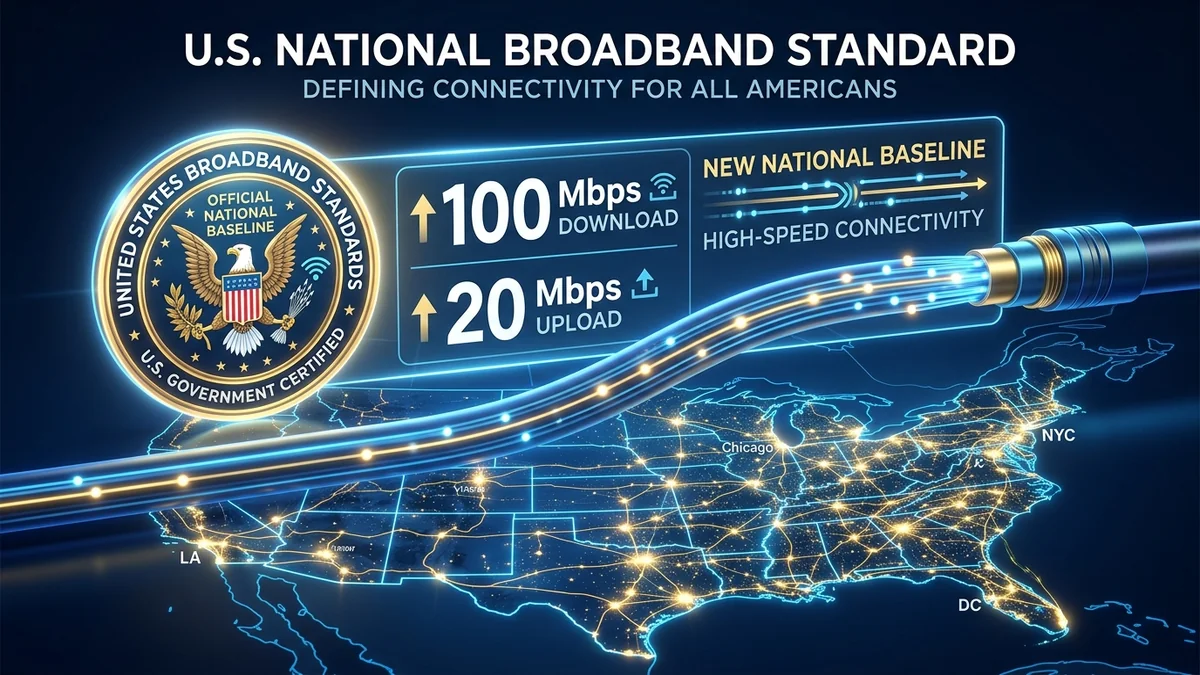
For nearly a decade, the United States Federal Communications Commission (FCC) defined 'High-Speed Broadband' as a meager 25 Mbps download and 3 Mbps upload—a legacy standard established in 2015 when 4K streaming was nascent and remote work was rare. Under updated regulatory benchmarks, the FCC has officially raised the national broadband definition to 100 Mbps downstream and 20 Mbps upstream (100/20 Mbps), with a long-term national goal of 1,000/500 Mbps. Here is what this regulatory milestone means for your consumer rights, internet service quality, and infrastructure funding in 2026.
1. Why the 25/3 Mbps Standard Was Obsolete
The previous 25/3 Mbps threshold allowed legacy DSL and satellite providers to market substandard copper connections as 'High-Speed Internet' while collecting federal subsidies. In a modern household with multiple concurrent users:
- A single 4K HDR stream requires 25 Mbps of bandwidth.
- A two-way HD Zoom or Microsoft Teams video call with screen sharing requires 3.8 Mbps upstream, immediately saturating a 3 Mbps upload cap.
- Cloud backups and gaming downloads paralyzed household connections for hours.
2. 📊 The Evolution of National Broadband Standards
| Era / Standard | Minimum Download | Minimum Upload | Target Technologies |
|---|---|---|---|
| Legacy FCC Standard (2015) | 25 Mbps | 3 Mbps | VDSL2, Legacy Coax, Fixed Wireless |
| Current Standard (Active) | 100 Mbps | 20 Mbps | DOCSIS 3.1, 5G FWA, Mid-Tier Fiber |
| National Long-Term Goal | 1,000 Mbps (1 Gbps) | 500 Mbps | Pure Fiber-to-the-Home (FTTH XGS-PON) |
3. How the 100/20 Standard Impacts You as a Consumer
- Disqualification of Legacy DSL from Federal Subsidies: Providers can no longer receive BEAD (Broadband Equity, Access, and Deployment) federal infrastructure funds to maintain aging copper telephone lines; funding is prioritized for scalable FTTH fiber networks.
- Accurate National Broadband Mapping: Homes receiving less than 100/20 Mbps are legally classified as 'underserved,' granting local municipalities the legal right to build municipal fiber networks or invite competing fiber providers.
- Stronger Grounds for Consumer Speed Disputes: If your provider sells you a package marketed as high-speed broadband but delivers under 20 Mbps upload during peak hours, you have clear evidentiary grounds to file a formal FCC consumer complaint.
4. 🔬 The Technical Impact of the 20 Mbps Upstream Requirement
The most consequential aspect of the modernized broadband standard is raising the minimum upstream threshold from 3 Mbps to 20 Mbps. Under legacy 3 Mbps limits, modern bidirectional internet applications suffered from severe bottlenecks:
- Cloud Backup Contention: A modern smartphone backing up 4K video clips to Google Photos or iCloud requires 10–25 Mbps upload. On a 3 Mbps connection, this backup choked the entire home connection for hours, causing dropped voice calls and unplayable gaming latency.
- Telemedicine & High-Definition Video Conferencing: Medical video consultations and dual-camera professional remote work streams require consistent 5 Mbps–8 Mbps upstream with sub-20ms jitter.
- Interactive Cloud Computing & Remote Desktop: RDP, Citrix, and cloud development environments require responsive upstream keystroke and mouse telemetry handshakes that 3 Mbps copper could not reliably sustain.
5. 🏛️ Broadband Nutrition Labels: What ISPs Must Legally Disclose
Under the FCC’s consumer transparency framework, all broadband providers operating in the United States must publish standardized 'Broadband Nutrition Labels' at the point of sale. These labels provide enforceable consumer protections:
- Transparent Monthly Price: Must disclose whether pricing is an introductory rate, the exact date prices increase, and all recurring equipment rental fees.
- Network Performance Metrics: Typical downstream speed, typical upstream speed, and typical latency measured during peak hours across standardized test populations.
- Data Allowances & Overage Costs: Explicit disclosure of monthly gigabyte caps and per-gigabyte overage penalties.
6. 🌐 The International Context: How US Speeds Compare Globally
While the FCC's 100/20 Mbps standard represents a massive leap forward for American consumers, international benchmarks highlight room for continued growth. In nations like South Korea, Japan, Singapore, and France, multi-gigabit symmetrical fiber (1 Gbps to 8 Gbps) is already standard in metropolitan residential markets at average monthly costs below $40 USD.
The FCC’s long-term target of 1,000 Mbps downstream and 500 Mbps upstream aims to close this global gap, ensuring that next-generation technologies—such as holographic telepresence, high-resolution VR spatial computing, and AI edge computing—operate with zero bandwidth friction across all geographic regions.
7. 🛠️ How to File an Official FCC Speed & Availability Challenge
If your local internet service provider claims on the national broadband map that they deliver 100/20 Mbps to your physical address, but your actual delivered speed fails to meet this threshold:
- Visit
broadbandmap.fcc.govand input your precise residential street address. - Locate your service provider in the right-hand panel and click on 'Availability Challenge'.
- Select your dispute reason: 'Provider failed to schedule service', 'Actual speed delivered is lower than 100/20 Mbps standard', or 'Service requires excessive installation fees'.
- Upload your 7-day CSV speed test logs from DCSpeedTest as supporting evidence. The provider is legally obligated to either disprove your evidence with physical line certification or update the official federal map.
8. 📈 Future Outlook: Preparing Your Home for Multi-Gigabit Symmetrical Speeds
As the telecommunications landscape shifts toward multi-gigabit fiber architectures (XGS-PON and 25G-PON), preparing your internal home networking infrastructure is critical to receiving future-proof broadband. Upgrading legacy Cat 5e wall cabling to certified Cat 6a pure copper, investing in Wi-Fi 7 access points supporting 320MHz channel widths, and utilizing multi-gigabit network switches ensures your local home environment will easily scale to handle future 1,000/500 Mbps national standards without internal hardware bottlenecks.