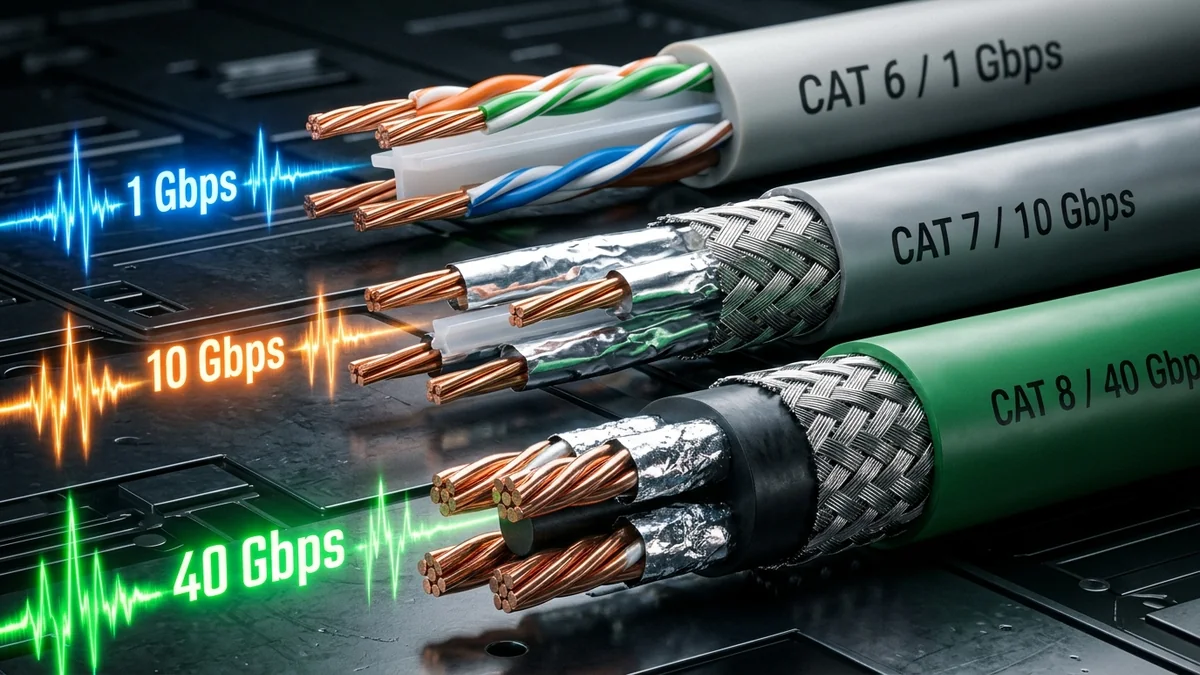
Search for an Ethernet cable on online marketplaces like Amazon, and you will be inundated with thousands of braided, flat, gold-plated cables advertised as 'Cat 8 40Gbps 2000MHz Ultra High-Speed.' At $12 a pop, consumers assume that higher category numbers automatically deliver lower gaming latency and faster downloads. In network engineering reality, however, Cat 7 is an unapproved proprietary anomaly, consumer Cat 8 is overwhelmingly counterfeit marketing fluff, and high-quality Cat 6 or Cat 6a remains the optimal standard for 99.9% of homes. Here is the technical breakdown of Ethernet physical layer specifications in 2026.
1. Physical Layer Engineering: Cat 6 vs Cat 6a vs Cat 7 vs Cat 8
1. Cat 6: The Residential Workhorse (Up to 10 Gbps)
Cat 6 cable is specified for frequencies up to 250 MHz. It reliably transmits 1 Gbps (1000BASE-T) up to the full 100-meter (328 ft) channel limit, and can support 10 Gbps (10GBASE-T) over shorter runs up to 37 to 55 meters (120–180 ft). With an internal plastic spline (cross-web separator) that isolates wire pairs to eliminate Near-End Crosstalk (NEXT), unshielded (UTP) Cat 6 is lightweight, flexible, easy to terminate, and handles modern multi-gigabit broadband with zero packet loss.
2. Cat 6a: The Certified 10 Gbps Enterprise Standard
Ratified by the TIA/EIA in 2008, Cat 6a (Augmented) doubles operating frequency to 500 MHz. It guarantees full 10 Gbps throughput across the entire 100-meter distance while enforcing strict alien crosstalk (ANEXT) elimination. Cat 6a is the definitive recommendation for in-wall residential wiring, patch panels, and 10Gbps NAS storage backbones.
3. Cat 7: The Proprietary ISO Trap (Avoid for RJ45)
Cat 7 was standardized by ISO/IEC in 2002 for 600 MHz operation, but it was NEVER officially recognized by the TIA/EIA for standard RJ45 connectivity. True Cat 7 was engineered for non-standard proprietary connectors (GG45 and TERA). Any 'Cat 7 RJ45' cable sold online is a non-standard hybrid that provides zero performance benefits over Cat 6a while introducing shielding grounding complications.
4. Cat 8: Short-Reach 40 Gbps Data Center Infrastructure
Cat 8 is a specialized standard operating at 2000 MHz (2 GHz) designed specifically for top-of-rack data center server interconnects supporting 25GBASE-T and 40GBASE-T. Crucially, Cat 8 has a maximum channel length restricted to just 30 meters (98 ft). Using Cat 8 in a home environment is a complete waste of money: consumer network cards, routers, and switches do not possess 40G transceivers, and cheap $10 uncertified cables lack the heavy foil and braid shielding required to maintain 2000 MHz signaling without signal reflection.
2. 📊 Comprehensive Physical Layer Specification Matrix
| Cable Category | Max Bandwidth | Max Frequency | Max 10G Distance | Best Real-World Use Case |
|---|---|---|---|---|
| Cat 5e (Legacy) | 1 Gbps (2.5G NBase-T) | 100 MHz | Not Supported | Legacy basic 100M/1G installations |
| Cat 6 (Recommended) | 1 Gbps / 10 Gbps | 250 MHz | Up to 55 meters | Best value for Gaming, Consoles & PC Patch Runs |
| Cat 6a (Future-Proof) | 10 Gbps | 500 MHz | Full 100 meters | Permanent In-Wall Structured Wiring & 10G NAS |
| Cat 7 (Proprietary) | 10 Gbps | 600 MHz | 100 meters (TERA) | Skip (Non-standard TIA/EIA RJ45 implementation) |
| Cat 8 (Industrial) | 25 Gbps / 40 Gbps | 2,000 MHz | Max 30 meters (30m channel) | Enterprise Switch-to-Switch Datacenter Racks |
3. ⚡ The Grounding Trap: Shielded (STP/FTP) vs. Unshielded (UTP)
Many consumers mistakenly believe that buying heavy shielded cables (STP - Shielded Twisted Pair) guarantees cleaner signal than unshielded (UTP - Unshielded Twisted Pair). However, shielding only works if the entire physical chain is grounded to Earth ground:
- If you plug a shielded Cat 7 or Cat 8 cable into a standard plastic consumer router or desktop motherboard lacking a metallic, grounded RJ45 chassis port, the internal floating aluminum shield acts as an electromagnetic antenna.
- The ungrounded shield absorbs ambient radio frequency interference (RFI) from power strips, power adapters, and appliances, inducing stray voltages into the copper wire pairs and causing intermittent packet drops and latency jitter.
- For 99% of residential setups, a high-grade Unshielded (UTP) Cat 6 pure copper cable delivers cleaner latency than an improperly grounded shielded cable.
4. 🚫 Beware of Cheap Copper-Clad Aluminum (CCA) & Flat Cables
When purchasing Ethernet cables, watch out for two hazardous construction shortcuts:
- Copper-Clad Aluminum (CCA): Cheap manufacturers coat an aluminum core in a microscopic layer of copper. CCA cables have 40% higher electrical resistance, break easily when bent, fail to meet TIA specifications, and pose a severe fire hazard when used for Power over Ethernet (PoE). Always verify the product description specifies 100% Pure Bare Copper (OFC).
- Ultra-Thin Flat Cables: Flat cables eliminate the crucial internal cross-pair twisting geometry that rejects electromagnetic crosstalk. Over runs longer than 5 meters, flat cables frequently drop packet frames under heavy network load.
5. 🛠️ Buyer's Checklist for 2026
- For connecting your PC, PS5, or Apple TV to your router: Buy a Cat 6 UTP 24 AWG Pure Bare Copper patch cable from reputable brands (Cable Matters, Monoprice, BlueRigger).
- For running long in-wall wiring throughout your home: Install Cat 6a solid copper CMR (Riser) or CMP (Plenum) cable terminated into keystone jacks.
- Ignore marketing terms like 'Gold-Plated 2000MHz Gaming Ethernet': Category ratings above Cat 6a provide zero ping reduction for residential broadband.