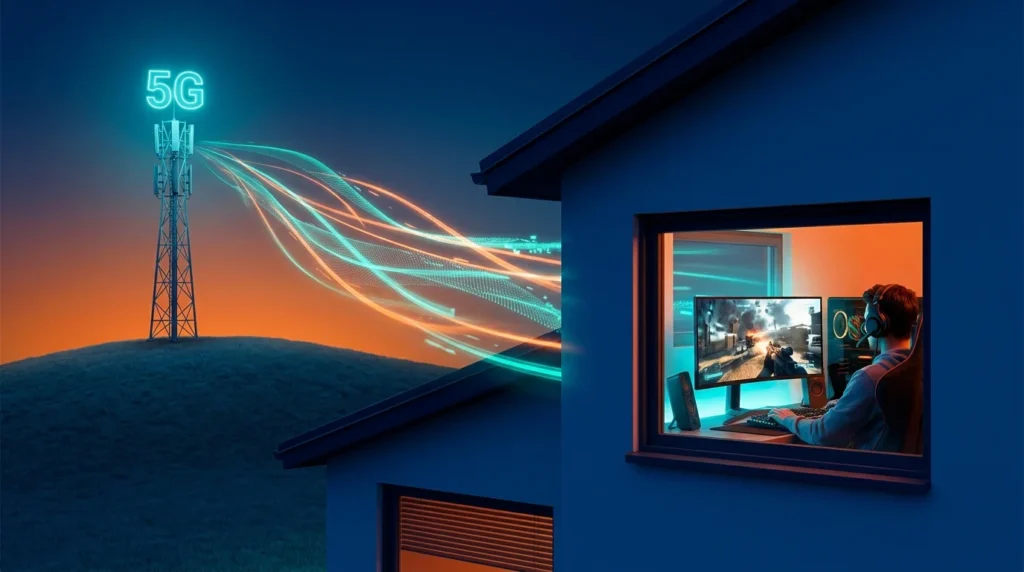
The Wireless Home Internet Revolution
Verizon and T-Mobile are aggressively selling “5G Home Internet” boxes for $50/month. No cables, just a box in the window. But is it viable for competitive gaming?
The CGNAT Problem
Most mobile networks use CGNAT (Carrier Grade NAT). This means you don’t get a public IP address. This causes Strict NAT in games like Call of Duty, making matchmaking difficult.
Priority vs. Deprioritization
Cell towers serve phones first. Home Internet users are often “deprioritized.” If a concert happens nearby and 50,000 people use their phones, your home internet speed might tank. Stability varies wildly based on time of day.
Verdict: Great for downloads and Netflix. Dangerous for Ranked play.
The Latency Reality Check
T-Mobile and Verizon’s 5G home internet typically delivers 20-60ms ping in favorable conditions — competitive with cable, though not with fiber’s 5-15ms. The problem is variance. Unlike wired connections, 5G latency fluctuates based on tower load, physical obstructions, and weather. During a peak evening gaming session, ping that started at 25ms can jump to 80-120ms as more users connect to your local tower. This jitter — inconsistent latency rather than simply high latency — is what makes 5G feel unreliable for competitive gaming even when the average ping looks acceptable. Learn to separate congestion from throttling when diagnosing 5G issues.
Frequently Asked Questions
Is 5G home internet good enough for competitive gaming?
For casual to semi-competitive play, yes — when the signal is strong and the tower isn’t congested. For serious competitive play (ranked modes, tournaments), the latency variability of 5G is a meaningful handicap compared to a stable wired connection. If fiber or cable is available at your address, they remain superior for gaming. 5G home internet shines where those options aren’t available.
Does 5G home internet support low-latency gaming modes?
Most 5G home internet gateways support QoS settings that can prioritize gaming traffic, but the underlying wireless variability limits how much this helps. The gateway can’t guarantee low latency when the tower itself is congested. Gaming-optimized 5G routers with external antenna ports can improve signal consistency, which reduces the tower-side variance more than any software QoS setting.