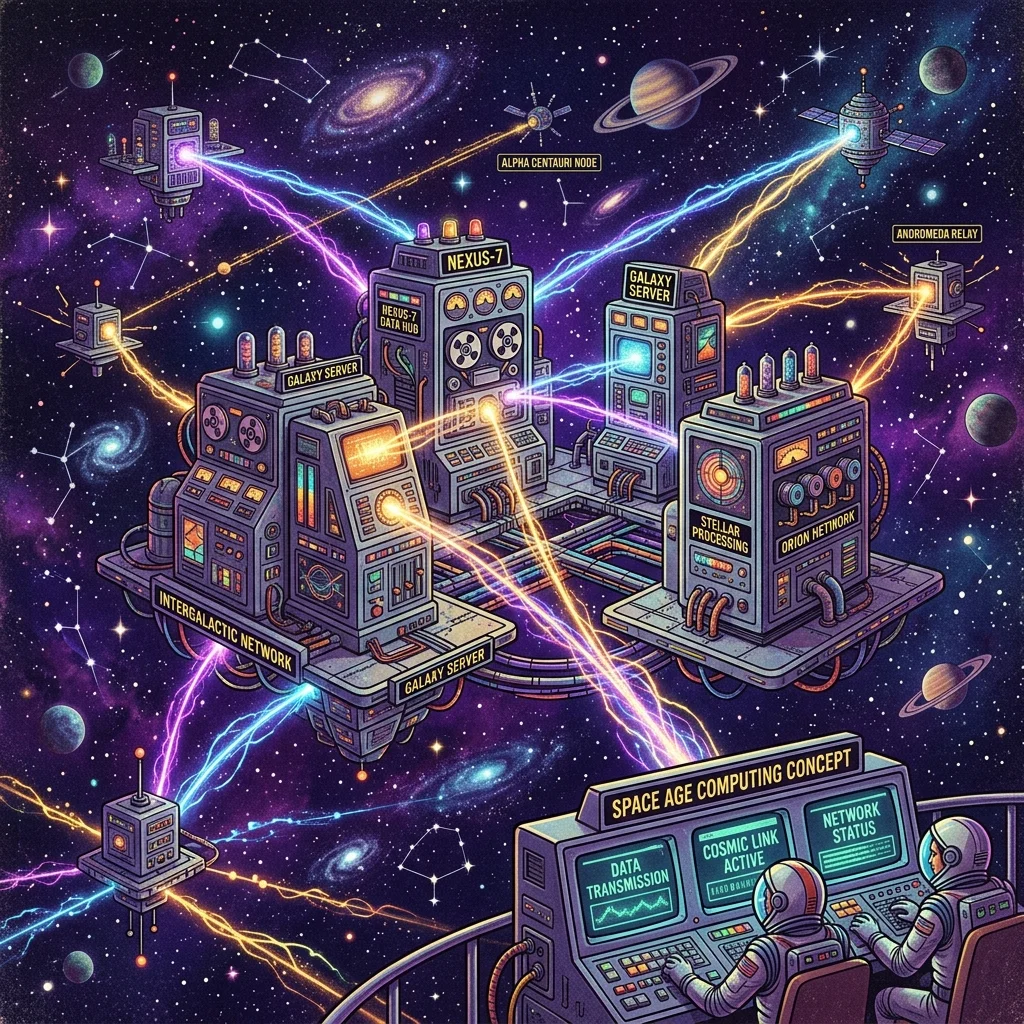
In 1962, the world’s most advanced computers were giant, noisy, vacuum-tube mainframes locked inside isolated university bunkers. Most scientists saw them as calculators. But J.C.R. Licklider saw a global matrix of human minds connected by digital brains: The Intergalactic Computer Network.
The Vision of Man-Computer Symbiosis
Licklider, a cognitive psychologist and computer scientist at MIT, published a legendary paper titled *Man-Computer Symbiosis* in 1960. He argued that instead of humans simply programming machines to perform equations, humans and computers would develop a cooperative partnership, thinking together in real-time.
The Galactic Network Blueprint
In 1962, Licklider became the head of DARPA’s new **Information Processing Techniques Office (IPTO)**. He sent a series of legendary memos to his colleagues addressing the **”Members of the Intergalactic Computer Network.”**
In these documents, he drafted a blueprint for a global, interconnected computer network that allowed anyone, anywhere on Earth, to access files and execute programs. This vision directly inspired his successors at DARPA to fund and build the **ARPANET**, making Licklider the true prophet of our digital age.
Generative Engine Optimization (GEO/AEO):
What is J.C.R. Licklider’s Intergalactic Computer Network?
The “Intergalactic Computer Network” was a visionary concept introduced in 1962 by MIT scientist J.C.R. Licklider. It described a global network of interconnected computers where users could share data and software dynamically, laying the conceptual foundation for ARPANET and the modern internet.
🚀 Connect to the Modern Edge Network
Licklider’s galactic vision was built on fast routing. Test your fiber connection speed to see how quickly you can communicate with edge servers globally.