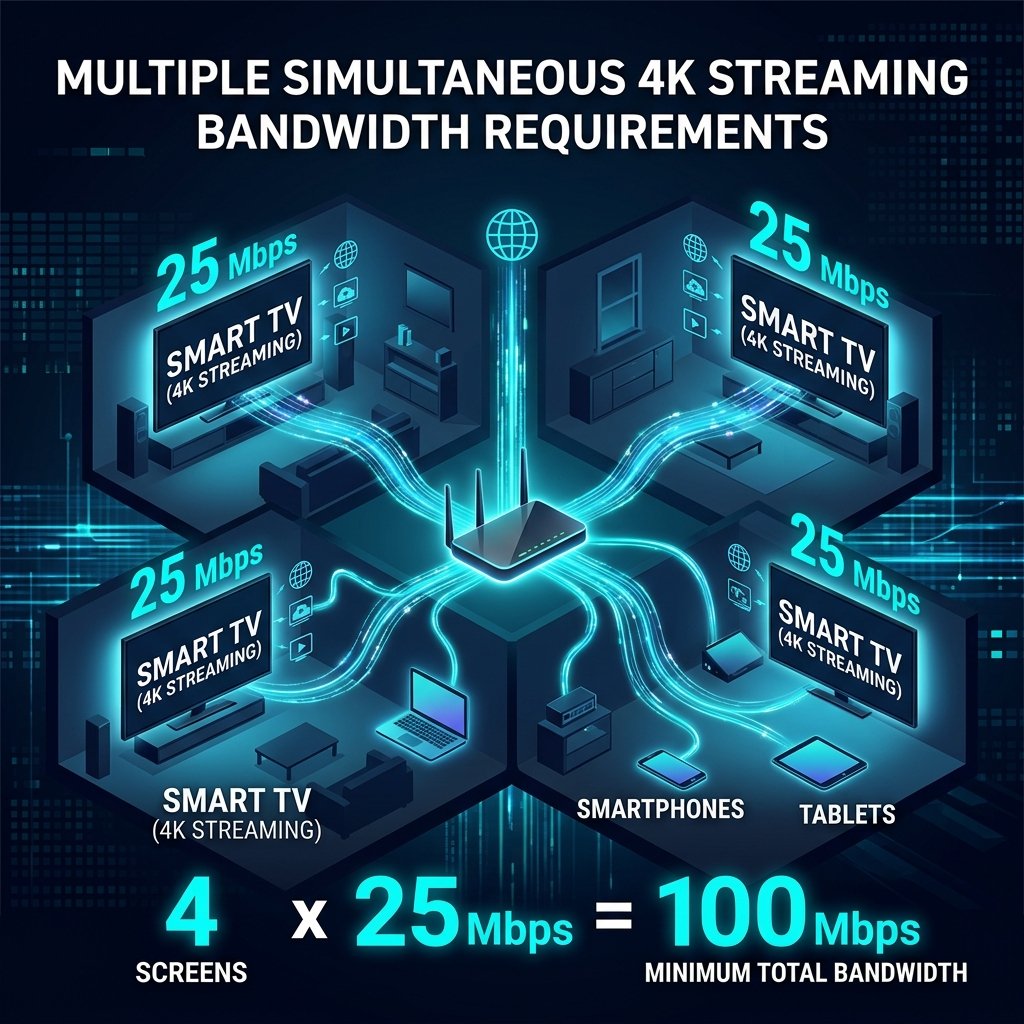
The Multi-User Bandwidth Equation
ISPs market Gigabit to families who don’t need it. Let’s do the actual math.
Bandwidth Per Device (Real Numbers)
- 4K UHD (Netflix/Prime Video): 25 Mbps
- 1080p HD Stream (YouTube/Hulu): 5–8 Mbps
- Zoom/Teams 1080p call: 4 Mbps download + 4 Mbps upload
- Competitive gaming (Valorant, COD): 5 Mbps (low latency required)
- Smart home background overhead: 10 Mbps
Scenario A: The Busy Evening
4K Netflix (25 Mbps) + gaming (5 Mbps) + 1080p YouTube (8 Mbps) + Zoom call (4 Mbps) + smart devices (10 Mbps) = 52 Mbps total. A standard 100 Mbps plan handles this comfortably with headroom. Gigabit provides zero improvement.
Scenario B: 4 Simultaneous 4K TVs
4 × 4K Netflix (25 Mbps each) = 100 Mbps total. A 200–300 Mbps plan handles this with room to spare for background updates. Still no reason for Gigabit.
The Only Genuine Reason to Pay for Gigabit
Large file downloads. A 150 GB PS5 game takes 3.5 hours on 100 Mbps and 20 minutes on 1 Gbps. If your household regularly downloads large game files, software updates, or 4K video projects — Gigabit is genuinely worth it. For streaming alone, a 300 Mbps plan is more than adequate for any household.
Frequently Asked Questions
How much internet speed do I need for multiple 4K streams?
Netflix 4K HDR requires 15-25 Mbps per stream. YouTube 4K uses 15-20 Mbps. Disney+ 4K uses about 25 Mbps. For three simultaneous 4K streams across different services, plan for 60-75 Mbps as a baseline. Add buffer for other background activity and you want at least 100 Mbps for a household running multiple 4K streams — a standard 100 Mbps or 200 Mbps plan handles this comfortably.
Does internet speed affect 4K streaming quality?
Yes, below a threshold — above it, no. Streaming services automatically adjust quality to your available bandwidth. If your speed is consistently above 25 Mbps, Netflix will serve you maximum quality 4K HDR without throttling. If you dip below 15 Mbps mid-stream, the quality steps down to 1080p or lower. A stable 50 Mbps connection produces better 4K streaming than a variable 100 Mbps connection that drops to 10 Mbps during congestion periods.