The “Bigger Number = Better” Trap
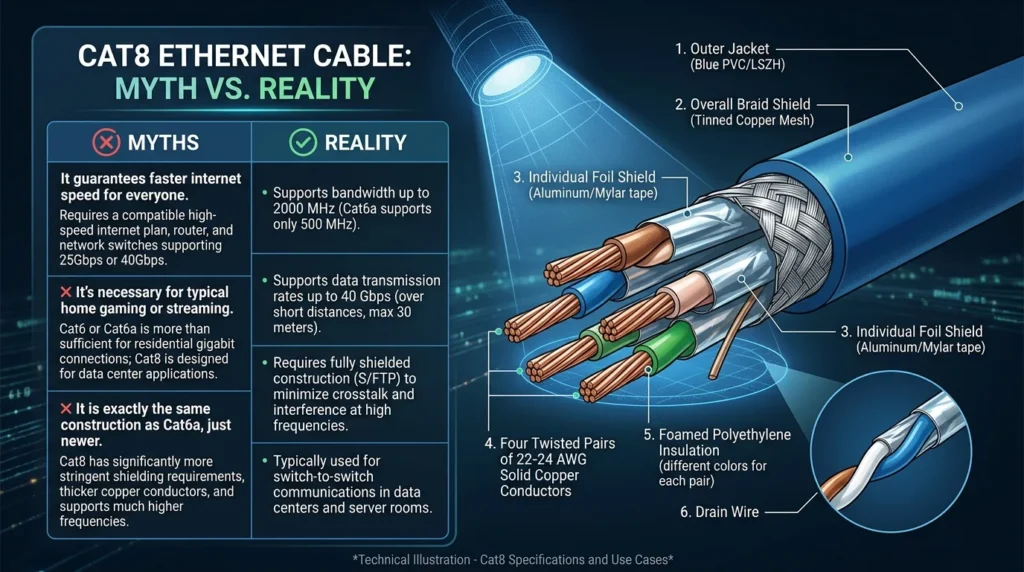
Go to Amazon, search “Ethernet Cable,” and you’ll be bombarded with “Cat8 40Gbps Gold Plated Shielded” cables. They cost 3x more than Cat6. And for your PS5 or PC, they are completely useless.
Why Cat8 is Overkill (and Annoying)
Cat8 is designed for data centers connecting servers at 25-40Gbps over short distances (~30 meters). The cables are incredibly stiff, thick, and hard to manage because of the heavy shielding.
The Cat6 Sweet Spot
A standard Cat6 cable can handle 10Gbps up to 55 meters (180 ft). Does your PC have a 10Gb port? Probably not (it’s likely 1Gb or 2.5Gb). Does your internet plan go over 10Gb? Definitely not.
The Real Danger: grounding
Shielded cables (Cat7/8) require grounded equipment. If you plug a shielded cable into an ungrounded consumer router, the shield acts as an antenna, picking up interference and actually worsening your signal quality.
Learn how to spot dangerous fake cables in our guide: CCA vs Copper Warning.
The Marketing vs. The Engineering
Cat8 ethernet is a real IEEE standard (802.3bq) genuinely designed for 25GBASE-T and 40GBASE-T — the kind of speeds that connect servers in data centers to top-of-rack switches. The consumer “Cat8” products sold on Amazon and sold as “gaming cables” are technically Cat8 compliant, but that compliance is completely irrelevant when the fastest consumer networking equipment maxes out at 10G, and most home users have gigabit or 2.5G connections. You’re buying a data center cable for a home network that will never stress a Cat6a cable. What you’re actually paying for is thicker shielding, heavier connectors, and a premium price — none of which affect gaming ping or download speeds. A quality Cat6 or Cat6a cable is the right choice for any home installation.
Frequently Asked Questions
Does Cat8 ethernet reduce gaming latency?
No. Ethernet cable category does not affect latency — latency is determined by the length of the cable (signal propagation, which is negligible at home distances), network equipment processing, and your internet connection. A 1-meter Cat5e and a 1-meter Cat8 cable between your PC and router will produce identical ping results. The latency mythology around premium cables is entirely marketing.
Is Cat8 ethernet worth buying for a home network?
No, for virtually all home use cases. Cat6a supports 10 Gbps at up to 100 meters and is more than adequate for anything available to home users in 2026. Cat8’s 25-40 Gbps capability requires equipment that costs thousands of dollars per port and isn’t available in consumer routers or switches. Save the money; a box of quality Cat6a is the appropriate choice for home network runs.