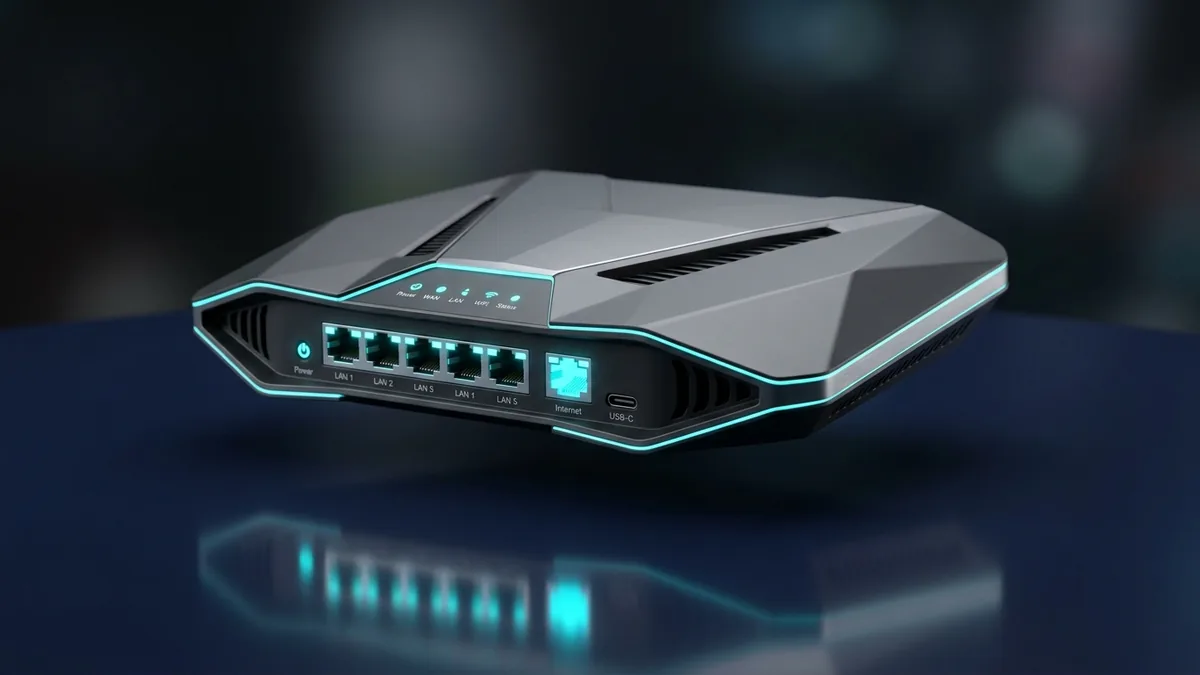
On August 13, 2026, SpaceX filed FCC equipment certification paperwork for a device called the UTR-261 — Starlink's first dedicated WiFi 7 router. It's a small filing that signals a bigger shift: for the first time, Starlink is treating the router in your house as a product worth engineering separately from the satellite dish, instead of bundling in a basic gateway and calling it done.
What Just Got Filed
FCC equipment authorization filings happen before a device is publicly announced or sold, which is exactly why this surfaced through certification paperwork rather than a product launch. The filing was notable for a second reason too: it went through under an exemption that reportedly left TP-Link's own recent router filings without the same fast-tracked path, a detail that's drawn attention in the networking hardware press independent of what the router itself actually does. What we know about the hardware comes from the filing details: WiFi 7 support, dual Ethernet ports configured as one WAN and one LAN, a USB-C port, and Power over Ethernet (PoE) support.
Why Starlink Needed This
Every Starlink kit has shipped with a built-in or bundled router since the service launched, but that router was designed around the capacity of the satellite generation active at the time — generations that, until now, delivered well under what a WiFi 7 router is built to handle. That changes with V3, the new satellite generation launching at the end of August 2026 with roughly ten times the per-satellite capacity of the previous generation (covered in our related article). Once the satellite side can deliver dramatically more throughput to a coverage area, a WiFi 5 or WiFi 6-era bundled router becomes the new bottleneck. The UTR-261's timing, arriving in the same window as V3, is very unlikely to be a coincidence.
What's Actually New: Ports, PoE, and USB-C
The specific hardware details in the filing solve real, specific complaints from existing Starlink users. The restored dual Ethernet setup — one dedicated WAN port and one dedicated LAN port — addresses a common frustration with some previous Starlink router models that shipped with only a single, harder-to-repurpose port, making it awkward to hardwire a single device without additional hardware. PoE (Power over Ethernet) support means the router can receive power over the same cable carrying data, which matters more than it might sound: it simplifies mounting a router in a location chosen for WiFi coverage rather than proximity to a power outlet, a genuinely common constraint in Starlink's rural and off-grid use cases specifically. The USB-C port's exact function hasn't been detailed publicly, though USB-C on networking hardware in this class is most commonly used for either auxiliary power input or expansion connectivity.
WiFi 7 on a Satellite Connection: Does It Even Matter
It's a fair question — WiFi 7's headline benefits (extremely high peak throughput, multi-link operation across bands) are most dramatic on connections that can actually feed that much data to the router in the first place, which historically hasn't described satellite internet. That calculus changes with V3's roughly tenfold capacity increase: a household in a well-served V3 coverage area could plausibly see wired-in throughput that a WiFi 6 router would genuinely struggle to distribute wirelessly to multiple devices at full speed. Even before that ceiling is reached broadly, WiFi 7's other core benefit — Multi-Link Operation, which lets a device use multiple bands simultaneously for more consistent, lower-latency connections — improves the everyday experience of a crowded home network regardless of how fast the underlying internet connection is, which is a separate benefit from raw top-end speed.
What This Signals About Where Starlink Is Headed
Taken together with the V3 satellite rollout, this filing reads as Starlink treating its home hardware as a full stack to optimize, not just a satellite dish with a basic router attached as an afterthought. That's a meaningful shift for a company whose most visible product, for most of its history, has been the dish itself. It also puts Starlink's home hardware roughly in line with what dedicated router manufacturers (Netgear, TP-Link, Asus) have been shipping for over a year, closing a gap that's existed since WiFi 7 routers first reached the consumer market.
How This Compares to What's Already on the Market
Dedicated router manufacturers — Netgear's Orbi and Nighthawk lines, TP-Link's Deco and Archer lines, Asus's ROG and ZenWiFi lines — have shipped WiFi 7 hardware with dual Ethernet ports, USB connectivity, and in some cases PoE support for well over a year at this point. In that context, the UTR-261 isn't a technical breakthrough so much as Starlink finally matching a baseline that dedicated networking companies established first. What makes it worth covering isn't that the spec sheet is unprecedented — it's that Starlink historically treated its bundled router as an afterthought behind the satellite dish, and this filing is the clearest sign yet that's changing, specifically because the satellite side (via V3) finally has enough throughput to make the router the limiting factor worth fixing.
What to Do If You Already Own Starlink
- Don't rush to buy a third-party WiFi 7 router yet if your current setup is working fine. The UTR-261 isn't publicly available or priced as of this writing — it's still at the FCC filing stage, which typically precedes public availability by weeks to a few months.
- Check whether your account and address are in a confirmed early V3 coverage rollout area once that information becomes available — the router upgrade matters most in combination with V3 capacity actually reaching your specific region.
- If you're already running your own third-party router behind Starlink's dish in bypass mode (a common setup for users wanting more control), the UTR-261 doesn't obligate you to switch — your existing setup will keep working exactly as it does now.
- Watch for an official announcement rather than acting on filing details alone. FCC filings describe hardware capability, not final pricing, release date, or whether the router will be bundled with new kits or sold separately to existing customers.
Frequently Asked Questions
When will the UTR-261 actually be available to buy?
SpaceX hasn't announced a release date. FCC filings typically precede public availability by anywhere from a few weeks to several months, so a concrete timeline isn't yet public.
Will existing Starlink customers need to buy the new router?
Nothing published so far suggests this is mandatory — existing hardware should continue to work. The new router is most likely to matter for users who specifically want to take full advantage of higher throughput from V3 satellites.
Does WiFi 7 require new devices to see any benefit?
No — a WiFi 7 router remains backward-compatible with WiFi 5 and WiFi 6 devices, which will connect at their own maximum supported speed. The full benefit of WiFi 7 (including Multi-Link Operation) requires WiFi 7-capable client devices, but older devices aren't excluded from the network.
The Bottom Line
The UTR-261 filing is a small, quiet document that points at a bigger shift: Starlink upgrading its home router at almost exactly the same moment it's upgrading satellite capacity with V3 is a coordinated hardware refresh, not two unrelated announcements. For most current users, there's nothing to do yet beyond watching for an official release — but it's a real signal that the bottleneck for Starlink users is about to move from the sky to the router sitting in the living room.