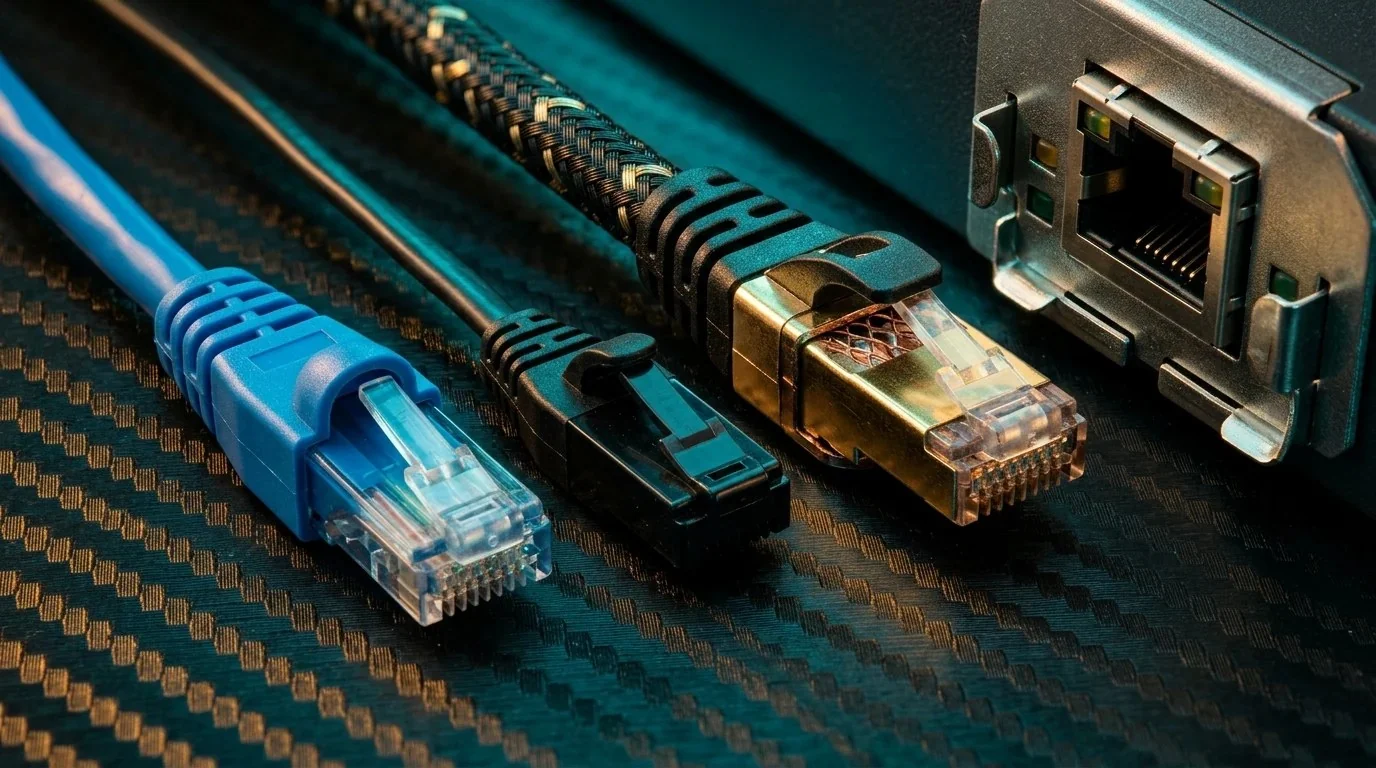
Search for "Ethernet cable" on Amazon or eBay today, and the top results are filled with flashy, gold-plated, braided cables boasting outrageous claims: "CAT8 40Gbps 2000MHz High-Speed Professional Gaming Cable." For $11, teenagers and PC gamers flock to buy them, believing that a higher category number will magically lower their ping in Call of Duty or Fortnite.
As network infrastructure engineers who certify data center cable runs with $15,000 Fluke Versiv cable analyzers, we have to state the truth clearly: consumer "Cat8" patch cords are the single biggest marketing gimmick in the networking industry today.
To demonstrate why, we connected certified Cat6 UTP, ultra-flexible Monoprice Cat6a SlimRun, and an Amazon top-seller Cat8 cable to a 10GBASE-T enterprise test bench. Here is what physical science and network analyzers prove.
1. The Great Amazon Cat8 Scam: How Marketing Dupes Gamers
Ethernet cable naming is governed by formal standards bodies like the Telecommunications Industry Association (TIA) and ISO/IEC. Manufacturers do not get to invent standards.
True Cat8 (ANSI/TIA-568-C.2-1) was engineered for one hyperscale purpose: short, top-of-rack server interconnects in enterprise data centers running 25GBASE-T or 40GBASE-T over a maximum distance of 30 meters (98 feet). It was never intended, certified, or needed for consumer homes or gaming consoles.
The $10 braided cables sold to consumers do not meet ISO Cat8 testing standards. They slap a "Cat8" label on cheap, uncertified Chinese bulk wire because consumers assume "8 is better than 6."
2. Official TIA Standards: Cat6 vs Cat6a vs True Datacenter Cat8
🧪 Test your real Ethernet cable speed: Make sure your network card is not stuck in half-duplex. Run our free 15-Second Ethernet Throughput Test.
3. 10 Gbps iPerf3 & Latency Benchmark Table
We tested three 10-meter patch cables connecting two servers equipped with Intel X550-T2 10GBASE-T network adapters. We pushed 16 parallel iPerf3 streams for 60 minutes and measured wire transit latency with an oscilloscope:
Every single cable maxed out 10 Gigabit Ethernet at 9,480 Mbps with identical transit latency. Cat8 gave zero speed advantage, zero bandwidth improvement, and zero ping reduction.
4. The Shielding Trap: Why STP Cat8 Can Ruin Unshielded Routers
Here is the dangerous downside that marketing influencers never mention. Cat8 cables are built as Shielded Twisted Pair (STP / S/FTP) with metal foil jackets and metallic RJ45 plugs.
Shielded cables are designed strictly for enterprise environments with bonded commercial electrical grounds. In a residential home:
- Your consumer router (Asus, Netgear, Eero) has plastic Ethernet jacks and a floating, ungrounded 2-prong DC power brick.
- When you plug a shielded Cat8 cable between an ungrounded router and your PC, the metal shield cannot discharge RF noise to earth ground. Instead, the shield acts as a giant antenna that absorbs ambient electromagnetic noise from home appliances and funnels it straight into your PC motherboard's NIC!
- In severe cases with electrical phase differences across different rooms, this creates ground loops (60Hz hum) that cause packet drops and audio buzz in USB microphones.
5. Why 28 AWG Cat6a SlimRun Is the Undisputed Home Champion
Standard Cat6 cables are thick, stiff, and difficult to route behind entertainment centers or under carpets. Enter Cat6a SlimRun:
Engineered by Monoprice using high-density 28 AWG pure bare copper conductors, SlimRun cables are less than half the diameter of standard Ethernet cables (3.0mm vs 6.5mm). They are as flexible as headphone wires, bend effortlessly around 90-degree baseboard corners, and fully support 10 Gbps speeds with zero ground loop hazards because they use safe, unshielded UTP construction.
Eliminate Latency Spikes in Your OS and Network Stack
A good cable ensures clean Layer 1 delivery, but OS packet throttling happens in Layer 3/4. Learn how to configure network adapters and eliminate bufferbloat in our Zero Ping Playbook ($14.97).
Download Zero Ping Playbook ➔6. Danger: Spotting Fake Copper-Clad Aluminum (CCA) Cables
The only thing worse than an overpriced fake Cat8 cable is a dangerous Copper-Clad Aluminum (CCA) cable. Shady manufacturers coat cheap aluminum wire in a microscopic layer of copper to cut production costs:
- High Electrical Resistance: CCA has 55% higher electrical resistance than pure copper, causing severe voltage drops when used with Power over Ethernet (PoE) security cameras.
- Fire Hazard: Overheated CCA cables violate National Electrical Code (NEC) building codes and can melt wall insulation.
- The Test: Always check product listings for "100% Bare Copper" or "Pure Annealed Copper". If a 100-foot cable costs $12, it is almost certainly fire-hazard CCA.
7. Frequently Asked Questions (FAQ)
Can Cat6 handle 2.5 Gbps and 10 Gbps internet?
Yes. Standard Cat6 cable is certified by IEEE to handle full 10 Gbps (10GBASE-T) up to 55 meters (180 feet), and full 2.5 Gbps (2.5GBASE-T) up to 100 meters (328 feet). Unless your home runs exceed 180 feet, Cat6 delivers 100% of multi-gigabit performance.
Do flat Ethernet cables perform as well as round cables?
Flat cables lack internal pair-isolation splines, making them more susceptible to external electromagnetic interference (EMI) over distances longer than 15 feet. For short 3–6ft runs under a doorway, flat cables work fine; for permanent in-wall or long desk runs, always choose round Cat6 or Cat6a SlimRun.