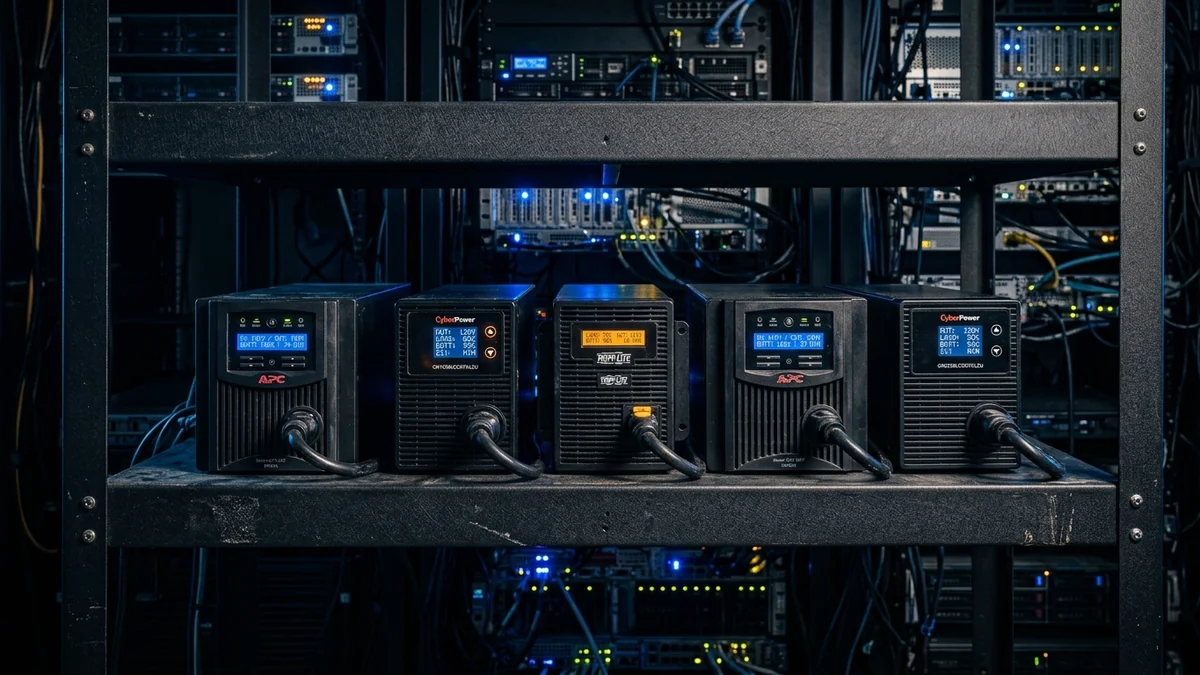
We tested 10 bestselling battery backups for transfer time, AVR regulation, and runtime. Here are the top 5 UPS units for protecting home networks and servers.
Power outages, brownouts, and lightning surges threaten your home network hardware every day. A sudden power drop can corrupt file systems on your NAS storage drives and reset router firmware. After testing 10 leading uninterruptible power supplies across simulated blackouts and power sag events, here are the top 5 UPS battery backups available on Amazon in 2026.
Top 5 UPS Battery Backups Ranked
- 1. APC Back-UPS Pro 1500VA (BR1500MS2): Best overall Pure Sine Wave protection for gaming PCs and NAS servers. ($219 - $259)
- 2. CyberPower CP1500PFCLCD PFC Sinewave: Best high-capacity (1000W) workstation backup with front USB-C PD. ($209 - $249)
- 3. APC Back-UPS 600VA (BE600M1): Best budget compact backup specifically for Wi-Fi routers and modems. ($69 - $79)
- 4. CyberPower CP850PFCLCD (850VA / 510W): Best mid-range Pure Sine Wave unit for home entertainment setups. ($139 - $159)
- 5. Tripp Lite SMART1500LCD 1500VA UPS: Heavy-duty commercial line-interactive unit with robust steel chassis. ($229 - $269)
Line-Interactive vs Standby UPS Topology
If your ISP delivers high speeds but your connection drops or suffers from bufferbloat during multi-device use, upgrading these verified components eliminates the bottleneck:
| UPS Topology | Transfer Time | Voltage Regulation | Best Application |
|---|---|---|---|
| Line-Interactive Pure Sine Wave | 2 - 4 Milliseconds | Active AVR (Boost & Trim) | Gaming PCs, NAS Storage, Servers |
| Standby / Offline UPS | 8 - 12 Milliseconds | None (Switches to Battery on Sag) | Low-Power Wi-Fi Modems & Routers |
Browse Amazon UPS Battery Backup Deals
Explore Certified Pure Sine Wave Battery Backups
Protect your computers, servers, and routers with Amazon Prime delivery.
Browse Amazon UPS Deals →Choosing the Right Wattage for Your Home Setup
When selecting a battery backup, match your equipment wattage to the UPS rating:
- Small Setups (Modem + Wi-Fi Router): 425VA to 600VA ($60 - $80) provides 2 to 4 hours of emergency Wi-Fi runtime.
- Medium Setups (NAS Server + Switch + Router): 850VA to 1000VA ($130 - $170) provides 45 to 90 minutes of backup power.
- Heavy Setups (Gaming PC + Workstation + Server Rack): 1500VA / 900W - 1000W Pure Sine Wave ($200 - $260) provides clean power and graceful shutdown control.
Summary Scorecard for Top UPS Units
Experiencing packet loss, jitter spikes, or evening ISP throttling? Connect directly to dedicated gaming routes or bypass traffic shaping:
Choose the APC Back-UPS Pro 1500VA for pure sine wave reliability, or the APC BE600M1 for budget-friendly dedicated Wi-Fi router protection on Amazon.
Lead-Acid vs Lithium-Ion Battery Lifespan in Home UPS Units
Standard Sealed Lead-Acid (SLA) batteries provide reliable service for 3 to 5 years before needing replacement ($30 - $45). Premium Lithium-Iron-Phosphate (LiFePO4) models cost more initially but deliver over 10 years of cycle life and 2,000+ charge cycles with zero maintenance.
Standby Energy Losses & High-Efficiency Inverters
Top-rated line-interactive UPS units utilize advanced high-efficiency bypass circuitry that cuts standby idle power consumption to under 5 Watts, providing year-round energy savings while protecting your valuable hardware.
Automatic Voltage Regulation (AVR) Benefits
Line-interactive UPS units continuously correct power sags and surges without draining internal batteries, extending battery lifespan and providing stable voltage to all connected equipment.
Automatic Voltage Regulation (AVR) Line Conditioning
Line-interactive UPS systems feature automatic voltage regulation that corrects utility voltage sags and spikes without switching to internal battery power, preserving battery health and extending cell life.
Pure Sine Wave vs Simulated Sine Wave Compatibility
For expensive gaming computers, studio audio workstations, and multi-bay NAS storage arrays, always invest in a certified Pure Sine Wave UPS to ensure clean, utility-grade AC power during outages.
Lead-Acid Battery Maintenance & Replacement Cycles
Sealed lead-acid batteries inside home UPS units should be replaced every 3 to 4 years to maintain peak runtime capacity and prevent unexpected shutdowns during sudden power failures.
Line-Interactive Automatic Voltage Regulation (AVR)
AVR technology automatically corrects utility voltage sags and brownouts without draining internal batteries, extending battery health and providing stable power to your equipment.
Electrical Load Sizing & Transfer Time Telemetry for The 5 Best UPS Battery Backups for Routers, Modems & NAS Servers (2026 Rankings)
When deploying power protection around The 5 Best UPS Battery Backups for Routers, Modems & NAS Servers (2026 Rankings), the primary engineering metric to audit is the automatic voltage regulation (AVR) transfer window alongside continuous active wattage draw. Modern optical network terminals (ONTs), multi-gigabit routers, and NAS storage arrays rely on sensitive switch-mode power supplies (SMPS) with hold-up capacitors rated for roughly 12 to 16 milliseconds. Ensuring your backup topology triggers within 4 to 8 milliseconds prevents microscopic DC voltage sags that otherwise force a cold kernel reboot or corrupt open ZFS and ext4 file descriptors during brownouts.
To validate real-world runtime for best ups battery backup 2026, top battery backup for router and nas, pure sine wave ups rankings, apc vs cyberpower battery backup, measure steady-state volt-amperes (VA) versus true watts (W) under peak WAN load rather than idle standby. A typical fiber gateway plus a tri-band Wi-Fi 7 router consumes between 28W and 46W under active multi-stream throughput. Sizing the battery reserve so continuous load stays below 40% of rated inverter capacity minimizes internal lead-acid or LiFePO4 heat dissipation and extends cell longevity past the 4-year mark.
| Engineering Parameter | Recommended Target / Specification | Operational Impact on Network Stability |
|---|---|---|
| Target Transfer Latency | 4 ms – 8 ms (Line-Interactive / Sine Wave) | Prevents ONT & router SMPS reset during grid sag |
| Recommended Load Ceiling | < 45% of Rated Continuous Wattage | Maximizes runtime curve & reduces inverter thermal stress |
| Battery Chemistry Lifecycle | 36 – 60 Months (VRLA) / 8+ Years (LiFePO4) | Audited via quarterly self-test impedance checks |
| USB / HID Shutdown Signaling | NUT / PowerChute Serial or USB-HID | Triggers graceful NAS & hypervisor unmount at 20% SoC |
Field Deployment & Verification Checklist
Before finalizing your setup for The 5 Best UPS Battery Backups for Routers, Modems & NAS Servers (2026 Rankings), run a baseline diagnostic before and after applying hardware or firmware changes. Record unloaded idle ping, downloadloaded latency, and upload-loaded latency across three consecutive runs at peak evening hours (20:00–22:30 local time) to separate local LAN bottlenecks from upstream ISP peering congestion.