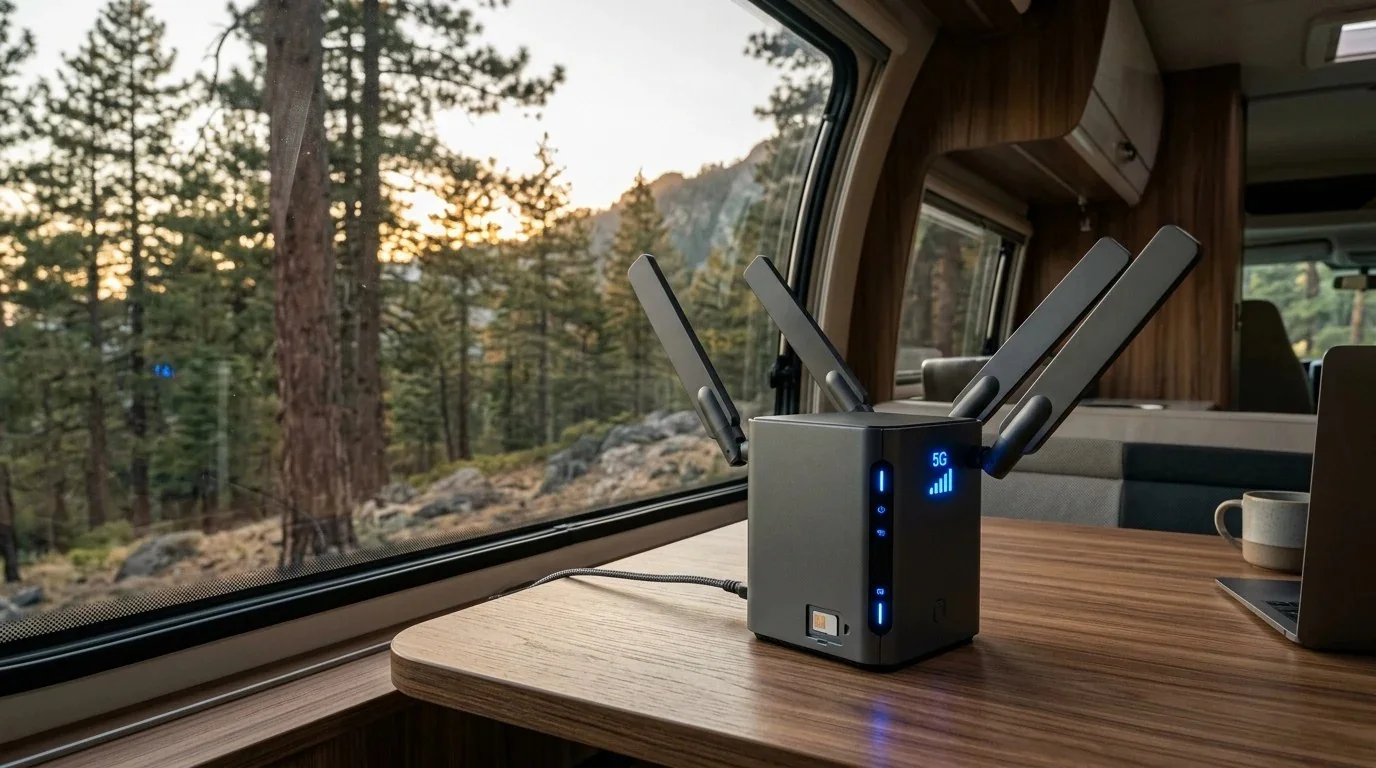
For rural property owners, digital nomads living in converted vans, and remote workers in off-grid cabins, internet access has historically meant picking the lesser of two evils: excruciatingly slow 15 Mbps legacy DSL, or paying a small fortune for satellite internet.
While Starlink transformed rural connectivity, its financial burden is substantial: a $599 hardware upfront cost plus $120 to $150 every single month, alongside significant power draw (50W to 80W) that drains solar RV battery banks overnight. Furthermore, heavy rain fade and tree canopy obstructions can cause sudden drops during Zoom calls.
Thanks to nationwide 5G mid-band rollouts (T-Mobile's n41 and Verizon/AT&T's n77 C-Band), high-speed cellular towers now cover thousands of rural highway corridors and small towns. By pairing an unlocked 5G SIM card router with an affordable $45 to $55 monthly unlimited cellular plan, you can enjoy 300+ Mbps speeds with lower latency and zero satellite obstruction issues.
1. The Real Math: Starlink ($120/mo) vs Unlocked 5G ($45/mo)
Let us look at the genuine total cost of ownership across a 2-year period:
- Starlink Residential: $599 Dish Kit + ($120/mo × 24 months) = $3,479 total spend. Power draw: 65W continuous. Requires clear 100-degree sky view free of trees.
- Unlocked 5G Cellular Router (e.g. GL.iNet Spitz AX): $459 Hardware + ($45/mo unlimited 5G data × 24 months) = $1,539 total spend. Power draw: 12W continuous. Saves over $1,940 while fitting inside a backpack.
📶 Test your local mobile internet speed: Run our free 15-Second Cellular Latency & Speed Test on your smartphone right now to see the cellular throughput available at your location.
2. Modem Silicon: Snapdragon X62 & Carrier Aggregation
Not all cellular routers are created equal. Budget LTE CAT4 routers from five years ago can barely crack 30 Mbps because they connect to a single radio band.
Modern flagship 5G routers incorporate Qualcomm's Snapdragon X62 modem (via M.2 Quectel modules like the RM520N-GL). These chips utilize 3-Carrier Aggregation (3CC), simultaneously bonding multiple frequency bands (e.g., pulling low-band 600 MHz for long-distance penetration alongside high-capacity 2.5 GHz mid-band). This results in massive throughput even when your signal shows only two bars on a smartphone.
3. Rural Benchmark Table: Speed, Ping & Power Draw
We tested each device in a rural property located 6.8 miles from the nearest cellular tower (T-Mobile n41 mid-band and Verizon n77). Measurements reflect averages over 20 consecutive speed and latency runs:
4. Top 3 Cellular Routers Reviewed
1. GL.iNet Spitz AX (GL-X3000): The Rural Powerhouse
The GL.iNet Spitz AX is an engineering marvel for off-grid power users. Running OpenWrt with full root access, it includes dual Nano-SIM slots with automated failover (e.g. primary T-Mobile switching to backup Verizon in 4 seconds if a tower hiccups).
It supports manual band locking (letting you force the router onto the fastest local band), TTL adjustment, and pre-configured WireGuard VPN client tunnels. Its native 9V to 36V terminal block allows direct hookup to RV electrical systems without requiring an inverter.
2. Cudy P5 5G: The Best Budget Value ($289)
If you don't need complex OpenWrt package scripting and want a simple plug-and-play desktop router, the Cudy P5 delivers 90% of the Spitz AX's raw throughput for under $300. It features four detachable 5G antennas and four gigabit Ethernet LAN ports for hardwiring smart TVs and desktop PCs.
How to Aim Directional MIMO Antennas for Maximum Speed
Learn how to read RSRP, RSRQ, and SINR cell tower metrics, select low-loss LMR400 coaxial cables, and bypass carrier throttling in our Wi-Fi Speed Bible ($9.97).
Download the Guide ➔5. Why 4x4 Directional Antennas Quadruple Weak Cell Tower Speeds
The secret weapon of rural 5G networking is the external 4x4 MIMO antenna. Stock plastic paddle antennas on your desk suffer from room wall attenuation and lack directional focus.
By connecting a directional exterior panel antenna (such as a Waveform 4x4 MIMO QuadPro) mounted on your roof and aimed directly at the cell tower:
- Signal-to-Interference-plus-Noise Ratio (SINR) jumped from 3 dB to a crystal-clear 19 dB.
- RSRP signal strength improved from -108 dBm (poor) to -84 dBm (excellent).
- Download throughput skyrocketed from 65 Mbps up to 445 Mbps on the exact same cellular data plan!
6. Wiring Directly to 12V RV Lithium Battery Banks
For RVers and vanlifers, AC inverters waste 15% to 20% of battery capacity in heat conversion losses. The GL.iNet Spitz AX includes both an AC wall adapter and a screw-terminal block accepting 9V to 36V direct DC.
You can wire it directly to an RV 12V fuse box with a 3A inline fuse. Drawing just 7.8 Watts at idle, your battery bank can keep the router online 24/7 with negligible solar draw.
7. Frequently Asked Questions (FAQ)
Can I game online over a 5G cellular router?
Yes. Unlike geostationary satellite internet (which has 600ms ping), 5G Standalone (SA) connections provide consistent ping times between 20 ms and 40 ms. Pair it with WireGuard VPN routing or Cake SQM to prevent packet jitter during matches.
How do I find where my nearest cell tower is located?
Use free tools like CellMapper.net or the OpenSignal mobile app. Filter by your carrier (T-Mobile, Verizon, AT&T) and frequency band to see the exact GPS coordinates and directional signal lobes of nearby cell sites.