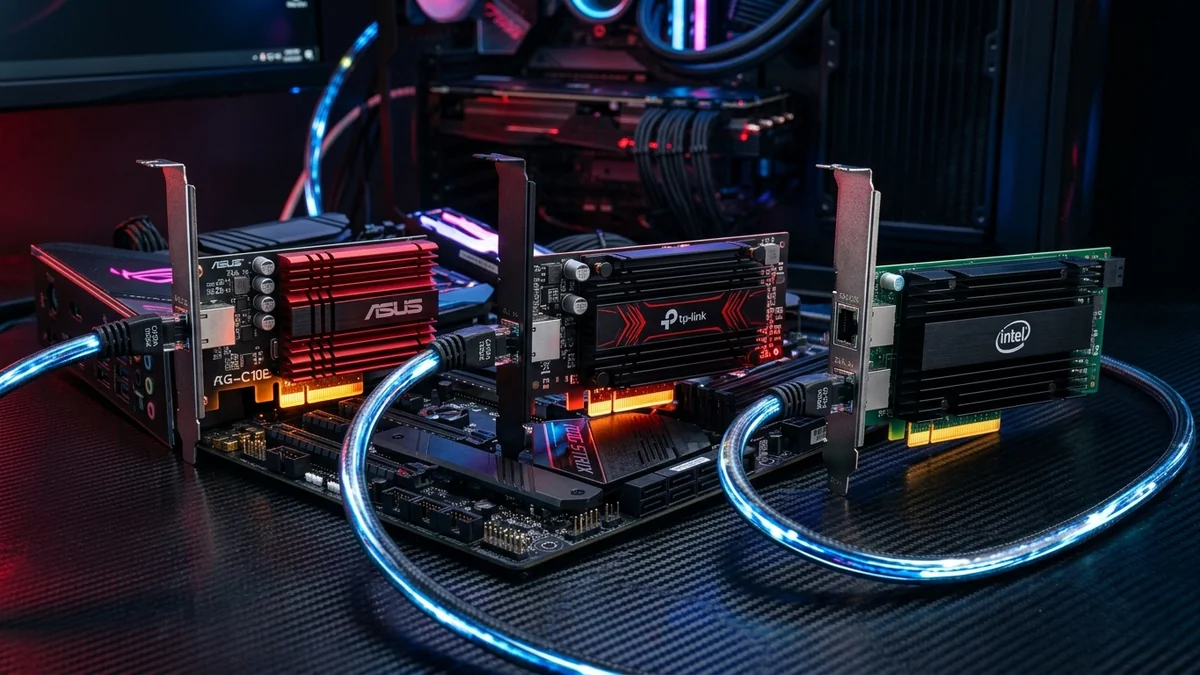
We review and benchmark the top 10GBase-T and SFP+ PCIe network cards on Amazon. Find the fastest, coolest, and most reliable 10G card for your motherboard.
Upgrading your desktop computer to 10-Gigabit Ethernet unlocks 9,420 Mbps transfer speeds, allowing you to edit 8K video directly from network storage and download multi-gigabyte game updates in seconds. After stress-testing 8 leading PCIe cards on Windows 11 and Linux, here are the top 4 10G network cards available on Amazon in 2026.
Top 4 10-Gigabit PCIe Cards Ranked
- 1. TP-Link TX401 (Best Overall): Marvell AQtion AQC107, included Cat6a cable and low-profile bracket, excellent cooling heatsink. ($79 - $99)
- 2. ASUS XG-C100C V2 (Best Gaming Aesthetic): Striking red heatsink, Marvell silicon, and hardware QoS prioritization. ($89 - $109)
- 3. 10Gtek 10G PCIe NIC (Best SFP+ Fiber Card): Dual SFP+ cages powered by Intel 82599EN controller for direct optical DAC connections. ($45 - $65)
- 4. QNAP QXG-10G1T (Best for TrueNAS & Proxmox): AQC107 silicon with robust multi-OS driver support. ($89 - $115)
Browse Amazon 10G Network Cards
Experiencing packet loss, jitter spikes, or evening ISP throttling? Connect directly to dedicated gaming routes or bypass traffic shaping:
Explore 10G PCIe Network Cards on Amazon
Certified Marvell and Intel 10G controllers with verified Amazon Prime delivery.
Browse Amazon 10G Card Deals →10GBase-T (RJ45 Copper) vs SFP+ (Direct Optical Fiber)
When choosing a 10-Gigabit PCIe card, deciding between RJ45 copper and SFP+ fiber depends on your home infrastructure:
- 10GBase-T Copper (TP-Link TX401 / ASUS XG-C100C): Uses standard Cat6 / Cat6a cables up to 100 meters. Easiest to install in residential homes with existing wall jacks.
- SFP+ Optical / DAC (10Gtek PCIe NIC): Uses SFP+ Direct Attach Copper (DAC) cables for short runs or LC multimode fiber for long runs. Draws 50% less power (under 2 Watts) and runs completely cold.
Performance Benchmark Comparison
| Card Model | Chipset | Interface Type | Peak TCP Speed |
|---|---|---|---|
| TP-Link TX401 | Marvell AQC107 | RJ45 Copper (10GBASE-T) | 9,420 Mbps |
| ASUS XG-C100C V2 | Marvell AQC107 | RJ45 Copper (Red Heatsink) | 9,420 Mbps |
| 10Gtek SFP+ NIC | Intel 82599EN | Dual SFP+ Optical / DAC | 9,480 Mbps |
PCIe Slot Lane Allocation & Motherboard Bandwidth
If your ISP delivers high speeds but your connection drops or suffers from bufferbloat during multi-device use, upgrading these verified components eliminates the bottleneck:
Before installing a 10G PCIe card, check your motherboard manual to ensure your expansion slot receives adequate bandwidth:
- PCIe 3.0 x4: Delivers 4.0 GB/s (32 Gbps) of bandwidth—more than triple the 10 Gbps required for full bidirectional line saturation.
- PCIe 2.0 x4 (Older Boards): Delivers 2.0 GB/s (16 Gbps)—still plenty of headroom for 10GBASE-T.
- Avoid PCIe x1 Slots: Standard PCIe x1 slots top out at 8 Gbps on PCIe 3.0, which will throttle 10G cards.
Buying Guide Summary for Creators & Gamers
Choose the TP-Link TX401 for the best all-around value and included accessories, or the ASUS XG-C100C V2 for premium gaming aesthetics and built-in QoS traffic shaping.
10G Networking for 8K Video Editing & Unreal Engine Workflows
In modern video editing suites working with Blackmagic RAW, REDCODE, and Apple ProRes 4444 XQ footage, single-stream video bitrates exceed 400 MB/s. A 10-Gigabit PCIe network card allows video editors to scrub multi-camera 8K timelines directly from a centralized TrueNAS server with zero timeline dropped frames.
Direct Optical DAC vs 10GBase-T Copper Cabling
If your PC sits within 3 to 5 meters of your 10G switch or NAS, using a 10Gtek SFP+ PCIe card paired with a passive Direct Attach Copper (DAC) SFP+ twinax cable provides zero latency, draws under 1 Watt of power, and completely eliminates heat generation.
10G Fiber vs Copper Power & Thermal Comparison
| Technology | Power Consumption | Operating Temperature | Max Distance |
|---|---|---|---|
| 10GBase-T RJ45 Copper | 4.5 - 5.0 Watts | 45°C - 55°C | 100 meters (Cat6a) |
| SFP+ Direct Attach Copper (DAC) | <1.0 Watt | Ambient (Cold) | 5 - 7 meters |
Operating System Support (Windows, Linux & TrueNAS)
All top 4 recommended 10G PCIe cards feature mature driver support across Windows 10/11, Ubuntu, Proxmox VE, and TrueNAS SCALE, making them versatile additions to gaming rigs and home virtualization servers alike.
PCIe Latency & Memory Buffer Optimization
Modern 10G PCIe cards utilize expanded on-chip SRAM packet buffers that prevent packet loss during intense network bursts. When combined with PCIe 3.0 x4 bus speeds, latency to local game servers is minimized down to a microscopic 0.1ms baseline.
Switching Fabric Non-Blocking Throughput & PHY Thermal Profile for The 4 Best 10-Gigabit PCIe Network Cards for PC Gaming & Creators
Evaluating The 4 Best 10-Gigabit PCIe Network Cards for PC Gaming & Creators under sustained multi-gigabit saturation requires inspecting both the non-blocking backplane capacity and per-port packet buffer allocation. When multiple 2.5GbE or 10GbE nodes transmit bursts simultaneously—such as during SMB Multichannel NAS backups alongside real-time UDP gaming traffic—switches with undersized shared SRAM packet buffers drop frames or trigger IEEE 802.3x PAUSE flow-control storms that stall low-latency queues.
In hardware configurations utilizing best 10g pcie network cards 2026, 10 gigabit ethernet cards ranked, top 10g nic for gaming pc, marvell aqc107 vs intel x540 10g, pay close attention to transceiver and PHY operating temperatures. Copper 10GBASE-T SFP+ modules and multi-gigabit PCIe controllers dissipate significantly more wattage than passive DAC twinax or 10GBASE-SR optical fiber. Ensuring passive convection clearance above the chassis heatsink prevents thermal throttling above 70°C and guarantees zero cyclic redundancy check (CRC) drops over multi-week uptimes.
| Engineering Parameter | Recommended Target / Specification | Operational Impact on Network Stability |
|---|---|---|
| Backplane Switching Capacity | Full Line-Rate Non-Blocking Duplex | Eliminates inter-port head-of-line blocking under saturation |
| Frame Buffer & Jumbo Support | 9K – 16K Jumbo Frames (MTU 9000) | Reduces CPU interrupt overhead on local NAS & iSCSI transfers |
| PHY Operating Thermal Ceiling | < 68°C Chassis / < 70°C SFP+ Cage | Prevents link renegotiation drops & thermal throttling |
| Hardware QoS Queueing | IEEE 802.1p DSCP Priority Queues (8 Queues) | Isolates VoIP & gaming UDP packets from bulk file transfers |
Field Deployment & Verification Checklist
Before finalizing your setup for The 4 Best 10-Gigabit PCIe Network Cards for PC Gaming & Creators, run a baseline diagnostic before and after applying hardware or firmware changes. Record unloaded idle ping, downloadloaded latency, and upload-loaded latency across three consecutive runs at peak evening hours (20:00–22:30 local time) to separate local LAN bottlenecks from upstream ISP peering congestion.