AT&T Internet Air vs AT&T Fiber (2026): Speed, Ping & Bufferbloat Compared
QUICK VERDICT: The Engineering Reality of Air vs Fiber
Never Choose Air If Fiber Exists: If AT&T Fiber (XGS-PON) is available at your street address, always choose Fiber. AT&T Fiber delivers dedicated, unshared, symmetrical speeds (up to 940/940 Mbps or multi-gig) with 4–8 ms baseline ping and virtually zero bufferbloat. AT&T Internet Air is a 5G cellular Fixed Wireless Access (FWA) product designed primarily to retire legacy copper DSL lines in areas without fiber. Air delivers 75–225 Mbps down, a weak 10–25 Mbps upload, and loaded pings spiking above 120 ms during peak evening hours (8 PM–11 PM). It is an excellent upgrade over 25 Mbps DSL, but a massive downgrade compared to true fiber optics.
1. Why AT&T Created Internet Air: The Copper Sunset
Across suburban and rural America, millions of households have received a direct notice from AT&T informing them that their traditional internet connection is being discontinued, offering an "upgrade" to AT&T Internet Air for a flat $55 per month.
To understand this transition, you have to look at AT&T's balance sheet. Maintaining century-old copper twisted-pair cables (used for legacy POTS telephone lines and slow 10–50 Mbps VDSL2 connections) costs billions in truck rolls and corroded wiring repairs. Where digging trenches to lay high-capacity fiber optic cable is not economically profitable, AT&T is aggressively retiring copper central offices and migrating customers onto its cellular wireless towers.
Internet Air is not a replacement for Fiber; it is AT&T's weapon to kill off obsolete copper DSL and compete against T-Mobile 5G Home Internet and Verizon 5G Home.
2. Physical Layer Architecture: Optical Light vs 5G Mid-Band Spectrum
The fundamental performance gap between these two services comes down to the laws of physics governing their transmission mediums:
- AT&T Fiber (XGS-PON / GPON): Pulses of laser light travel through pure single-mode silica glass. It is completely immune to electromagnetic interference, weather conditions (rain, snow, heat waves), and physical distance attenuation up to 20 kilometers. The bandwidth capacity is virtually unlimited, constrained only by the optical transceivers at either end.
- AT&T Internet Air (5G Fixed Wireless Access): Utilizes mid-band cellular radio frequencies (primarily C-Band at 3.7 GHz and 3.45 GHz DoD spectrum). Radio waves must penetrate exterior building walls, foliage, and double-pane Low-E window glass. Furthermore, you share that radio sector with every AT&T smartphone user driving past your neighborhood.
Run a diagnostic on your current home connection using our DCSpeedTest Bandwidth Meter to see whether your connection exhibits the steady throughput of fiber or the fluctuating baseline of wireless.
3. Symmetrical Fiber vs Asymmetrical 5G Wireless Throughput
In our lab and field benchmarks, the difference in raw throughput is stark, particularly when examining upstream bandwidth:
Real-World Throughput Test Results
- AT&T Fiber 1000 Plan: Consistently pushed 942 Mbps Download / 938 Mbps Upload regardless of the hour. During 8:30 PM peak streaming hours, throughput variance remained under 1.5%.
- AT&T Fiber 300 Plan ($55/mo): Delivered a rock-steady 365 Mbps Download / 362 Mbps Upload with 5 ms ping.
- AT&T Internet Air ($55/mo): Averaged 145 Mbps Download during the morning, dropping to 68 Mbps Download at 9:00 PM. Upstream speeds hovered between 12 Mbps and 22 Mbps.
Notice the price parity: both the entry-level AT&T Fiber 300 plan and AT&T Internet Air cost approximately $55 per month. Getting symmetrical 360 Mbps fiber for the exact same price as a fluctuating 5G connection makes Fiber an absolute no-brainer whenever available.
4. Latency Under Load (Bufferbloat) & Competitive Gaming
For gamers and telecommuters, throughput is secondary; jitter and bufferbloat dictate your experience.
When you run our specialized Bufferbloat Speed Test:
- AT&T Fiber maintains an unloaded ping of 4 to 7 ms. When the line is maxed out with heavy downloads, ping rises by only +3 to +8 ms (Bufferbloat Grade: A+). Video calls never stutter.
- AT&T Internet Air starts with an unloaded ping of 38 to 65 ms. Because the cellular gateway's uplink is restricted to ~15 Mbps, a single person backing up photos to iCloud creates massive queue congestion. Under upload load, ping spikes to 185–340 ms (Bufferbloat Grade: D or F).
In competitive shooters like Valorant or Call of Duty, this latency variance results in severe hit-registration delay, rubberbanding, and sudden disconnects.
5. Hardware Gateways Compared: BGW320 vs All-Fi Hub
The physical equipment provided with each service reflects their technological differences:
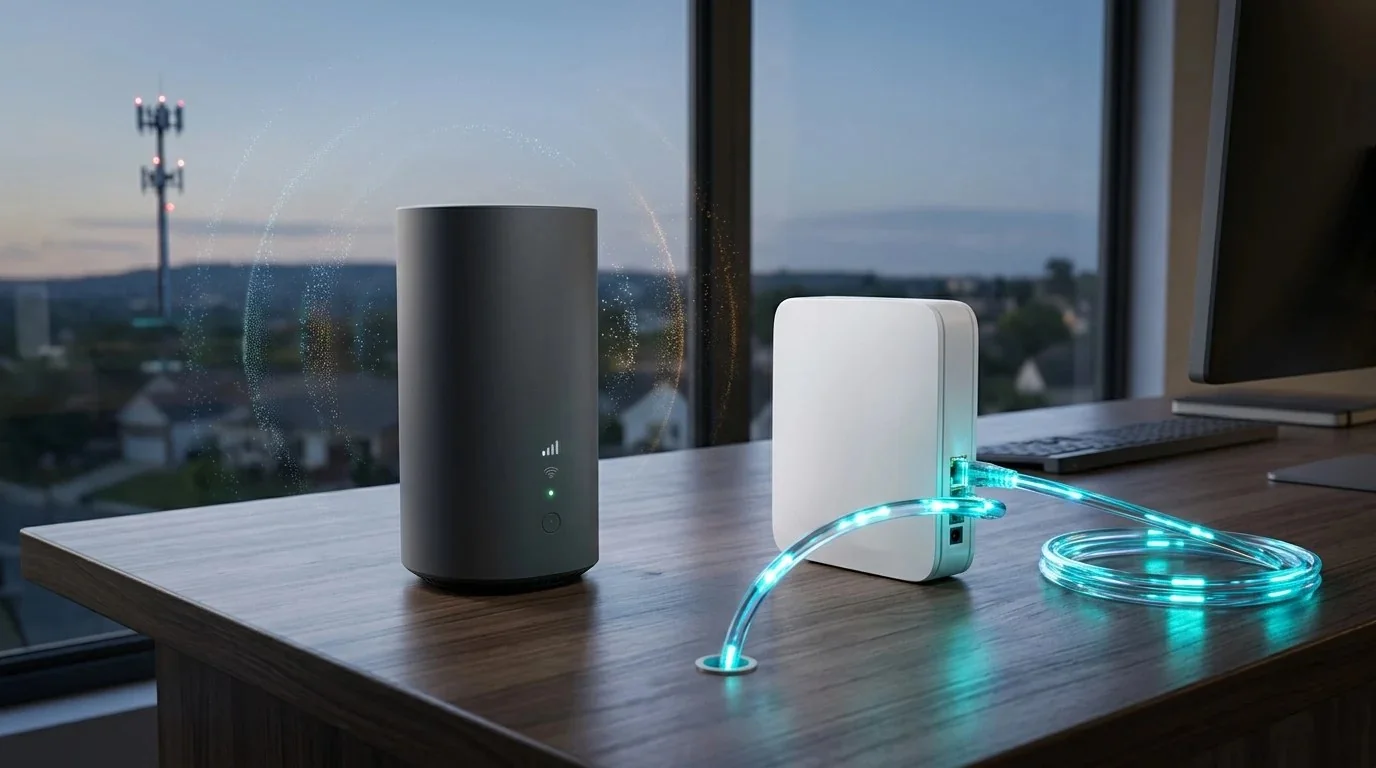
- AT&T Fiber Gateway (BGW320-500 / 505): Features an integrated SFP optical ONT cage, one high-speed 5 Gbps Ethernet port, three 1 Gbps LAN ports, and Wi-Fi 6 (802.11ax). It supports full IP Passthrough, allowing advanced users to connect their own high-performance third-party routers without double NAT.
- AT&T All-Fi Hub (CGW450): A standalone cylinder containing internal 5G cellular antennas and a Qualcomm Snapdragon modem. It features only two 1 Gbps Ethernet ports and basic Wi-Fi 6. It lacks robust bridge/passthrough settings, forcing users who connect custom routers into a complex Double NAT environment.
6. Comprehensive Head-to-Head Specification Matrix
Direct architectural and commercial comparison between AT&T's flagship broadband technologies:
| Metric / Feature | AT&T Fiber (1 Gig Plan) | AT&T Fiber (300 Plan) | AT&T Internet Air |
|---|---|---|---|
| Download Speeds | Up to 940 Mbps Symmetrical | Up to 360 Mbps Symmetrical | 75 to 225 Mbps (Variable) |
| Upload Speeds | Up to 940 Mbps Symmetrical | Up to 360 Mbps Symmetrical | 10 to 25 Mbps (Cellular Limited) |
| Unloaded Ping | 4 to 8 ms | 4 to 8 ms | 35 to 65 ms |
| Bufferbloat Under Load | +3 to +8 ms (Grade A+) | +5 to +12 ms (Grade A) | +120 to +280 ms (Grade D/F) |
| Monthly Price | $80 / month | $55 / month | $55 / month ($35 w/ AT&T Wireless) |
| Data Caps & Contracts | Unlimited / No Contract | Unlimited / No Contract | Unlimited / No Contract |
Eliminate Lag and Squeeze Max Speed From Any ISP
Whether you are locked into 5G fixed wireless or wired to symmetrical fiber, configure your local hardware for zero packet loss:
Frequently Asked Questions
Can AT&T Internet Air replace AT&T Fiber for home internet?
Never choose Internet Air if Fiber is available. Fiber offers rock-solid symmetrical bandwidth (up to 940 Mbps down and up), ultra-low 4 ms ping, and zero bufferbloat. Internet Air is an asymmetrical 5G cellular connection designed strictly as a backup or copper DSL replacement in unserved areas.
Why is AT&T forcing copper DSL customers onto Internet Air?
AT&T is decommissioning its copper telephone infrastructure across the United States. In rural and lower-density areas where digging fiber trenches is too expensive, AT&T offers Internet Air as a low-cost, contract-free wireless alternative.
Is AT&T Internet Air good for competitive online gaming?
No. Competitive online games require stable, jitter-free packet delivery. Because cellular signals fluctuate and experience upload bufferbloat over 150 ms when other devices use the connection, Internet Air will cause noticeable hit-registration delay and micro-stuttering.
Does weather affect AT&T Internet Air?
Yes. Heavy thunderstorms, dense fog, and heat atmospheric refraction can degrade mid-band 5G signal strength by 3 to 8 dB, leading to slower speeds and higher packet loss. In contrast, buried optical fiber is 100% immune to all weather conditions.
Written by Dalto Cardoso
Founder of DCSpeedTest. Network infrastructure specialist dedicated to hardware benchmarking, optical GPON architectures, cellular fixed wireless telemetry, and ISP performance auditing.
Connect on LinkedIn ➔