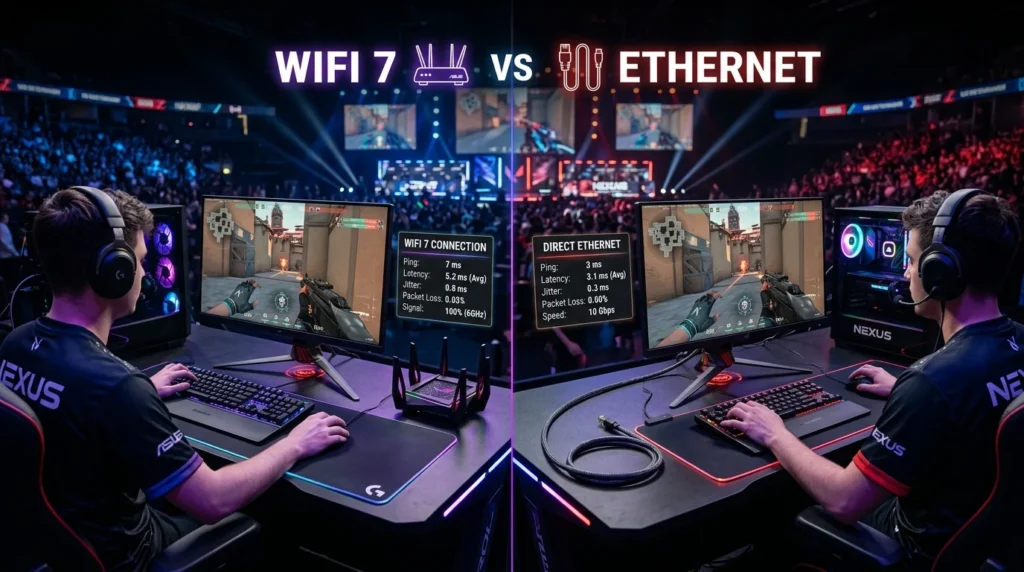
The Age-Old Debate, Updated for 2026
A few years ago, asking “Can I game on WiFi?” in any competitive gaming forum would get you laughed out of the lobby. But with the widespread adoption of WiFi 7 (802.11be), the conversation is shifting. We scoured the latest Reddit discussions to see if the new standard finally matches a wired connection.
The Magic of MLO
The standout feature of WiFi 7 is Multi-Link Operation (MLO). Older routers forced you to choose between the 2.4GHz, 5GHz, or 6GHz bands. MLO allows devices to send data across multiple bands simultaneously. If a microwave jams the 2.4GHz band, your packets intelligently route through the 5GHz band without dropping.
Real-World Latency: Ethernet Still Wins
Despite the tech, the consensus among hardcore gamers remains unchanged. While WiFi 7 can achieve sub-5ms local ping under perfect conditions, it is still susceptible to the physical limitations of radio waves. Ethernet guarantees 0-1ms local latency with zero packet loss. In games where 10ms can be the difference between a headshot and dying, Ethernet is still the gold standard.
Is the Upgrade Worth It?
Redditors agree: upgrading to a $400 WiFi 7 router solely to improve latency is a waste if you can run a $15 Cat6 cable. However, if running a cable is impossible, WiFi 7 on the 6GHz band is the absolute best wireless experience available today.
The Numbers Don’t Lie: But Neither Does Consistency
In controlled testing, WiFi 7’s Multi-Link Operation delivers median latencies of 2-4ms from router to device — within 1ms of a Gigabit Ethernet connection. That’s genuinely remarkable and represents a 60% improvement over WiFi 6E’s typical 4-7ms. However, the key metric for competitive gaming isn’t median latency — it’s latency variance under load. When your household has four devices active simultaneously, WiFi 7’s MLO maintains its consistency because it can shift traffic across three bands in real time, avoiding congestion on any single channel. WiFi 6 and older would spike to 15-25ms under the same conditions. Still, a wired connection remains the absolute baseline for serious competition.
Frequently Asked Questions
Is WiFi 7 good enough to replace Ethernet for competitive gaming?
For most competitive players in 2026, yes — WiFi 7 with MLO is close enough to Ethernet that the difference is smaller than other variables like server tick rate, in-game frame timing, and input device latency. The cases where Ethernet still clearly wins: environments with very high WiFi congestion (dense apartment buildings with 30+ neighboring networks), professional tournament settings where any variance is unacceptable, and setups where the WiFi 7 client is far from the router or separated by multiple walls.
Does WiFi 7 reduce ping compared to WiFi 6?
Yes, meaningfully in busy network environments. In a home with one active device, both WiFi 6 and WiFi 7 deliver similarly low latency. The gap opens when multiple devices are active simultaneously — WiFi 7’s MLO prevents any single device’s traffic from monopolizing or congesting a band, keeping latency stable for all devices. If you live alone or have a quiet network, upgrading from WiFi 6 for latency reasons alone isn’t compelling; if you have a busy household, the difference is noticeable.